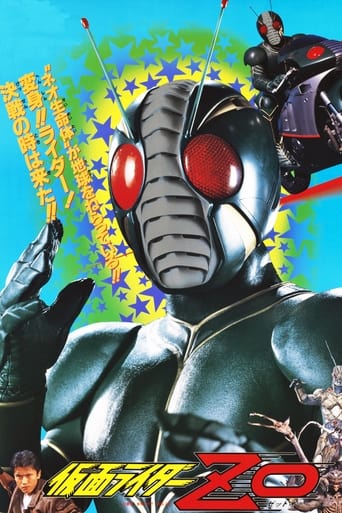
Kamen Rider ZO (1993)
仮面ライダーZO
A Neo-Life Form is threatening Earth!! Transform!! Rider! It's time to settle the score!!
Masaru Aso was the lab assistant of geneticist Doctor Mochizuki, used as one of his experiments related the creation of the Neo Organism, enabling him to transform into a grasshopper-like being called Kamen Rider ZO. He fled into the mountainside and went into a coma before he was awakened by a telepathic call two years later with an unconscious urge to protect Hiroshi Mochizuki, the son of Doctor Mochizuki.
- Date of release
- 1993-04-17
- TMDB
- 7.3 / 10 (25)
- Runtime
- 50m
- Genres
- Action, Adventure, Science Fiction
- Director
- Keita Amemiya
Casting
- Hiroshi Tsuchikado — Masaru Asou / Kamen Rider ZO
- Isao Sasaki — Doctor Mochizuki
- Shohei Shibata — Hiroshi Mochizuki
- Hiroshi Inuzuka — Seikichi Mochizuki
- Naomi Morinaga — Reiko
- Kenji Ohba — Kuroda
- Masaru Yamashita — Nishimura
- Iori Sakakibara — Miyazaki
- Shingo Yuzawa — Neo Organism / Doras (voice)
Interesting facts
Kamen Rider ZO , translated Masked Rider ZO, is a 1993 Japanese tokusatsu superhero film directed by Keita Amemiya, and co-produced between Toei Company and Bandai. A Sega CD interactive movie, The Masked Rider: Kamen Rider ZO, was released in 1994.
Production
The idea for the project was conceived due to the strong sales of Shin Kamen Rider: Prologue, which was released through direct-to-video. Many proposals were planned such as sequel to Shin, or a feature film featuring Ichigo to Black RX. However, it was decided that it would be a standalone film.
Shigeru Okada, then president of Toei Video, Ryonori Watanabe, and Makoto Yamashina, then president of Bandai Visual, proposed a joint project on the condition that it would push box office sales through a multi-million yen campaign. Okada was one of the first to green-light the film. He then collaborated with Yamashina and planned to release the upcoming film by next May.
There were restrictions on producing ZO from within the company, but Okada pulled through and decided to produce the film over a year before its eventual release. In March 1992, the decision to produce the film had begun and an multichannel marketing was deployed for potential box-office sales, such as film, television events, and merchandise sales.
It was planned as a standalone release theatrically because it was an anniversary film. However, due to potential box-office risks, executives created the Toei Super Hero Fair and was shown alongside the theatrical versions of Gosei Sentai Dairanger and Tokusou Robo Janperson. For that reason, ZO's runtime was shortened at 48 minutes than the envisioned 90, causing the film's development to be rushed.
Production of the film had begun on November 19, 1992. The film had finished principal photography on December 20, 1992, and was officially completed on February 3, 1993.
Read on Wikipedia · Text from Wikipedia, CC BY-SA 4.0. Data from Wikidata.
Recommended
- Shin Ultraman 2022 · ★ 7.5
- Attack on Titan II: End of the World 2015 · ★ 6.3
- My Hero Academia: Heroes Rising 2019 · ★ 8.1
- Godzilla vs. SpaceGodzilla 1994 · ★ 6.7
- Pacific Rim: Uprising 2018 · ★ 6.1
- Inuyashiki 2018 · ★ 7.7
- Mazinger Z: Infinity 2017 · ★ 7.0
- Hunter x Hunter: Phantom Rouge 2013 · ★ 7.1
- Godzilla vs. Megalon 1973 · ★ 6.2
- My Hero Academia: You're Next 2024 · ★ 7.3
- Justice League x RWBY: Super Heroes & Huntsmen, Part Two 2023 · ★ 6.9
- Justice League: Gods and Monsters 2015 · ★ 7.1