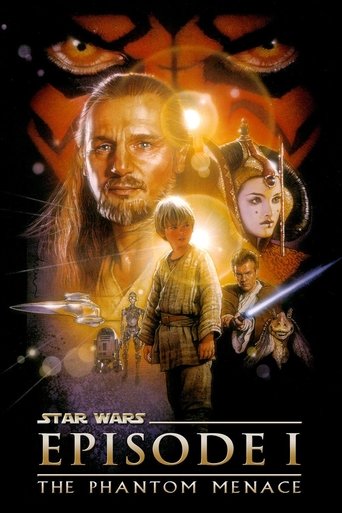
Star Wars: Episode I - The Phantom Menace (1999)
Every saga has a beginning.
Anakin Skywalker, a young slave strong with the Force, is discovered on Tatooine. Meanwhile, the evil Sith have returned, enacting their plot for revenge against the Jedi.
- Date of release
- 1999-05-19
- TMDB
- 6.6 / 10 (16472)
- Runtime
- 2h 16m
- Genres
- Adventure, Action, Science Fiction
- Director
- George Lucas
- Collection
- Star Wars Collection
Casting
- Liam Neeson — Qui-Gon Jinn
- Ewan McGregor — Obi-Wan Kenobi
- Natalie Portman — Padmé Amidala
- Jake Lloyd — Anakin Skywalker
- Ian McDiarmid — Senator Palpatine
- Pernilla August — Shmi Skywalker
- Oliver Ford Davies — Governor Sio Bibble
- Hugh Quarshie — Captain Panaka
- Ahmed Best — Jar Jar Binks
- Anthony Daniels — C-3PO (voice)
- Kenny Baker — R2-D2
- Frank Oz — Yoda (voice)
Interesting facts
- Box office: $1B
- Budget: $115M
- Earned 8.9× its budget
- Filmed in: Warner Bros. Studios, Leavesden, Cassiobury Park, Tunisia, Palace of Caserta, Whippendell Wood, and Hever Castle
- Awards: 0 · Nominations: 4
Star Wars: Episode I – The Phantom Menace is a 1999 American epic space opera film written and directed by George Lucas in his first directorial effort since the original Star Wars, released in 1977. Produced by Lucasfilm Ltd. and distributed by 20th Century Fox, it is the fourth film in the Star Wars film series, the first film of the prequel trilogy and the first chronological chapter of the "Skywalker Saga." The film stars Liam Neeson, Ewan McGregor, Natalie Portman, Jake Lloyd, Ahmed Best, Ian McDiarmid, Anthony Daniels, Kenny Baker, Pernilla August, and Frank Oz. It is set 32 years before the original trilogy, during the era of the Galactic Republic.
Production
While writing the original Star Wars film (1977), George Lucas decided the story was too vast to be covered in one film. He introduced a wider story arc that could be told in sequels if it became successful. He negotiated a contract that allowed him to make two sequels, and over time created an elaborate backstory to aid his writing process.
In the early 1980s, Mark Hamill and Anthony Daniels discussed the potential prequels with the BBC. In 1980, Hamill said after finishing the trilogy, they would "go back 20 years" and focus on stories of a young Darth Vader and young Obi-Wan Kenobi and hinted that a five or six year old Luke Skywalker could appear in the third prequel preceding A New Hope.
Throughout the 1980s, Lucas said he had no desire to return to Star Wars and had canceled his sequel trilogy by the time of Return of the Jedi. However, because Lucas had developed most of the backstory, the idea of prequels continued to fascinate him. In the early 1990s, Star Wars saw a resurgence in popularity in the wake of Dark Horse's comic line and Timothy Zahn's trilogy of novels.
Lucas began writing the Star Wars prequel trilogy on November 1, 1994. The screenplay of Star Wars was adapted from Lucas's 15-page outline that was written in 1976, which he designed to help him keep track of the characters' backstories and events that occurred before the original trilogy.
The larger budget and possibilities opened up by the use of digital effects made Lucas "think about a much grander, more epic scale—which is what I wanted Star Wars to be". The story ended with five simultaneous, ongoing plots, one leading to another.
Read on Wikipedia · Text from Wikipedia, CC BY-SA 4.0. Data from Wikidata.
Recommended
- Star Wars: The Rise of Skywalker 2019 · ★ 6.2
- Solo: A Star Wars Story 2018 · ★ 6.5
- The Mandalorian and Grogu 2026 · ★ 7.4
- Star Trek Into Darkness 2013 · ★ 7.3
- Rebel Moon - Part Two: The Scargiver 2024 · ★ 6.0
- Babylon 5: The Lost Tales - Voices in the Dark 2007 · ★ 6.4
- The Empire Strikes Back 1980 · ★ 8.4
- Star Wars: Episode III - Revenge of the Sith 2005 · ★ 7.5
- Beneath the Planet of the Apes 1970 · ★ 6.1
- Rogue One: A Star Wars Story 2016 · ★ 7.5
- Star Trek Beyond 2016 · ★ 6.8
- Avatar: Fire and Ash 2025 · ★ 7.6