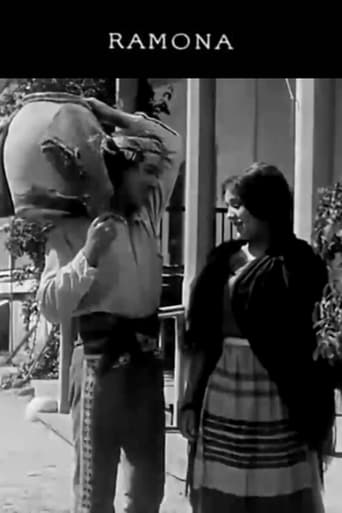
Ramona (1910)
A Story of the White Man's Injustice to the Indian
Ramona, residing on her wealthy Spanish adoptive mother's rancho in California, falls in love with the Indian Alessandro. When Ramona is denied permission to marry Alessandro, the lovers elope, only to find a life of great hardship and unhappiness amidst the greed and injustice of the white landowners.
- Date of release
- 1910-05-23
- TMDB
- 4.9 / 10 (19)
- Runtime
- 17m
- Genres
- Drama, Romance, Western
- Director
- D.W. Griffith
Casting
- Mary Pickford — Ramona
- Henry B. Walthall — Alessandro
- Francis J. Grandon — Felipe
- Kate Bruce — The Mother
- W. Chrystie Miller — The Priest
- Charles West — Man in Chapel
- Dorothy West — Woman in Chapel
- Frank Opperman — Ranch Hand
- Gertrude Claire — Woman in West
- Mack Sennett — The White Exploiter
- Jack Pickford — A Boy
- Dell Henderson — Man at Burial
Interesting facts
- Based on: Ramona
Ramona is a 1910 American silent drama film directed by D. W. Griffith, based on Helen Hunt Jackson's 1884 novel Ramona. Through a love story, the early short explores racial injustice against Native Americans and stars Mary Pickford and Henry B. Walthall. A print survives in the Library of Congress film archive. The film was remade in 1928 with Dolores del Río and in 1936 with Loretta Young.
Production
Advertisements for the film stated that it was made "by arrangement with Little, Brown, & Company," the publishers of Jackson's novel. The film was shot on location in Ventura County, California, "at identical locations wherein Mrs. Jackson placed her characters."
At the time D. W. Griffith directed Ramona, the Biograph production company was experiencing financial difficulties. Still based in New York and competing with the now-fragmented Edison Company, Biograph was in search of new creative direction. Griffith joined the company in 1908 as a writer and actor. Soon after, the company's head director, Wallace McCutcheon, became ill, and his son was unable to maintain the role.
Griffith's frequent collaborator Billy Bitzer served as cinematographer. Bitzer had originally been hired as an electrician at Biograph, but his interest in photography led him to become a pioneering figure in early cinema. He was known for experimenting with lighting and close-up techniques.
Read on Wikipedia · Text from Wikipedia, CC BY-SA 4.0. Data from Wikidata.
Recommended
- Brokeback Mountain 2005 · ★ 7.8
- A Love Song 2022 · ★ 6.6
- The Unforgiven 1960 · ★ 6.2
- Stolen Women, Captured Hearts 1997 · ★ 7.6
- The Outsider 2002 · ★ 5.9
- The World to Come 2021 · ★ 7.0
- Train Dreams 2025 · ★ 7.3
- Frontera 2014 · ★ 6.5
- The Homesman 2014 · ★ 6.5
- Hollywood Dirt 2017 · ★ 6.4
- The Sleeping Dictionary 2003 · ★ 6.6
- The Claim 2000 · ★ 6.0