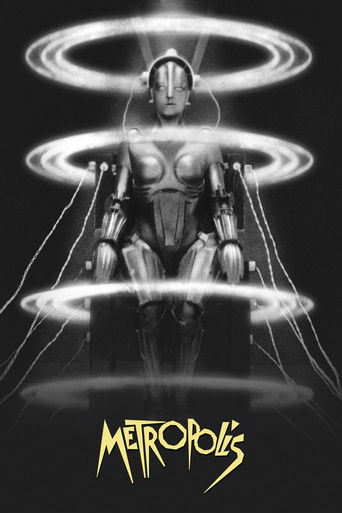
Metropolis (1927)
There can be no understanding between the hands and the brain unless the heart acts as mediator.
In a futuristic city sharply divided between the rich and the poor, the son of the city's mastermind meets a prophet who predicts the coming of a savior to mediate their differences.
- Date of release
- 1927-01-10
- TMDB
- 8.1 / 10 (3279)
- Runtime
- 2h 28m
- Genres
- Drama, Science Fiction
- Director
- Fritz Lang
Casting
- Gustav Fröhlich — Freder Fredersen
- Brigitte Helm — Maria / The Machine Man
- Alfred Abel — Johann 'Joh' Fredersen
- Rudolf Klein-Rogge — C.A. Rotwang
- Theodor Loos — Josaphat
- Fritz Rasp — The Thin Man
- Erwin Biswanger — No. 11811 - Georgy
- Heinrich George — Grot
- Fritz Alberti — Creative Human - Man Who Convinces Babel (uncredited)
- Grete Berger — Working Woman (uncredited)
- Olly Boeheim — Working Woman (uncredited)
- Heinrich Gotho — Master of Ceremonies (uncredited)
Interesting facts
- Based on: Metropolis
- Filmed in: Berlin
Metropolis is a 1927 German expressionist science-fiction, silent film directed by Fritz Lang and written by Thea von Harbou in collaboration with Lang, based on von Harbou's 1925 novel of the same name. It stars Brigitte Helm, Gustav Fröhlich, Alfred Abel, and Rudolf Klein-Rogge. Erich Pommer produced it in the Babelsberg Studio for Universum Film A.G. (UFA). Metropolis is regarded as a pioneering science-fiction film, being among the first feature-length ones of that genre. Filming took place over 17 months in 1925–1926 at a cost of more than five million Reichsmarks, or the equivalent of about €21 million.
Production
Metropolis's screenplay was written by Thea von Harbou, a popular writer in Weimar Germany, jointly with Lang, her then-husband. The film's plot originated from a novel of the same title written by von Harbou for the sole purpose of being made into a film. The novel in turn drew inspiration from H.G. Wells, Mary Shelley and Villiers de l'Isle-Adam's works and other German dramas.
The screenplay itself went through many rewrites, and at one point featured an ending where Freder flew to the stars; this plot element later became the basis for Lang's Woman in the Moon.
The period in which Metropolis is set has been interpreted in various ways. In the preface to the 1925 novel, Thea von Harbou states that the story takes place "at no particular place or time, neither in the present nor in the future." The 1963 American edition published by Ace Books, with a foreword by Forrest J Ackerman, placed the action in "The World of 2026 A.D.", roughly a century after the film was made.
On 22 May 1925, Metropolis began principal photography with an initial budget of 1.5 million ℛ︁ℳ︁. Lang cast two unknowns with little film experience in the lead roles. Gustav Fröhlich (Freder) had worked in vaudeville and was originally employed as an extra on Metropolis before Thea von Harbou recommended him to Lang.
Shooting of the film was a draining experience for the actors involved due to the demands that Lang placed on them. For the scene where the workers' city was flooded, Helm and 500 children from the poorest districts of Berlin had to work for 14 days in a pool of water that Lang intentionally kept at a low temperature.
Read on Wikipedia · Text from Wikipedia, CC BY-SA 4.0. Data from Wikidata.
Recommended
- 1984 1956 · ★ 6.5
- Insurgent 2015 · ★ 6.4
- The Electric State 2025 · ★ 6.5
- The Giver 2014 · ★ 6.6
- Mortal Engines 2018 · ★ 6.3
- 9 2009 · ★ 7.0
- The Time Machine 2002 · ★ 6.4
- Paycheck 2003 · ★ 6.2
- The Dark Tower 2017 · ★ 5.8
- Logan's Run 1976 · ★ 6.6
- 2073 2024 · ★ 6.7
- Chaos Walking 2021 · ★ 6.5