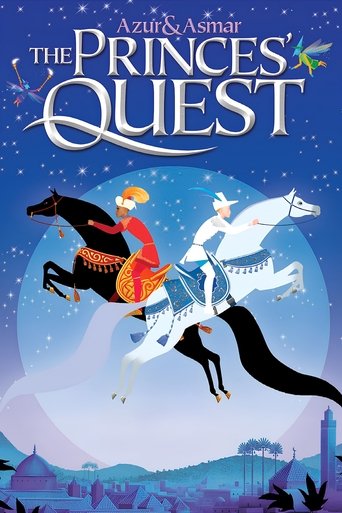
Azur & Asmar: The Princes' Quest (2006)
Azur et Asmar
Raised on tales of a Djinn fairy princess, Azur, a young Frenchman goes to North Africa in search of the sprite, only to discover that his close childhood friend, Asmar, an Arab youth whose mother raised both boys also seeks the genie.
- Date of release
- 2006-10-25
- TMDB
- 7.7 / 10 (682)
- Runtime
- 1h 39m
- Genres
- Animation, Family
- Director
- Michel Ocelot
Casting
- Cyril Mourali — Azur (voice)
- Rayan Mahjoub — Azur enfant (voice)
- Karim M'Ribah — Asmar (voice)
- Abdelsselem ben Amar — Asmar enfant (voice)
- Hiam Abbass — Jenane (voice)
- Patrick Timsit — Crapoux (voice)
- Fatma ben Khell — Princesse Chamsous Sabah (voice)
- Thissa d'Avila Bensalah — La Fée des djinns (voice)
- Sofia Boutella — La Fée des elfes (voice)
- Olivier Claverie — Yadoa, le sage (voice)
- Jacques Pater — Le père d'Azur (voice)
- Tayeb Belmihoub — (voice)
Interesting facts
- Box office: $11.9M
- Budget: €9M
- Awards: 0 · Nominations: 1
Azur & Asmar: The Princes' Quest is a 2006 animated fairytale fantasy film written and directed by Michel Ocelot and animated at the Paris animation and visual effects studio Mac Guff Ligne. It was released in theaters in North America as just Azur & Asmar.
Production
Michel Ocelot conceived his film as a ''celebration of the Maghreb and Islamic civilization in the Middle Ages''. Having cherished memories of a trip to Algeria during his adolescence, he visited the ''three countries of the Maghreb to sketch the scenery for his film''. The city of Timgad particularly marked him. From another trip in 2001, the Bastion 23 and the Bardo Museum in Algiers inspired him a "beautiful Moorish dwelling."
For the characters’ costumes, Ocelot particularly researched using a book about Algerian costume and those seen in the Bardo Museum. The women in the film wear Berber outfits, and the headdress of the Djinn Fairy is inspired by a headdress preserved in the Bardo Museum in Algiers Algeria.
The journey of Azur and Asmar to the land across the sea is a means of evoking the theme of immigration and the difficulty of being an immigrant. This is why the dialogues in Arabic in the film are neither dubbed nor subtitled: ''One of the problems of the immigrant is also not understanding or being understood''.
The film is entirely created using computer animation.
Concerned with maintaining the authenticity of the Arabic language, Ocelot enlisted Hiam Abbass, a Palestinian screenwriter, director, and author, to verify the dialogues. Hiam Abbass also provided the voice for the mother and nurse character of Azur and Asmar.
Read on Wikipedia · Text from Wikipedia, CC BY-SA 4.0. Data from Wikidata.
Recommended
- Tinker Bell 2008 · ★ 7.0
- Barbie: A Fairy Secret 2011 · ★ 6.9
- Barbie: Fairytopia 2005 · ★ 6.8
- Barbie Fairytopia: Magic of the Rainbow 2007 · ★ 6.9
- Cinderella and the Secret Prince 2018 · ★ 6.5
- Charming 2018 · ★ 6.4
- Pil's Adventures 2021 · ★ 6.7
- Tinker Bell and the Legend of the NeverBeast 2014 · ★ 7.4
- Barbie as Rapunzel 2002 · ★ 7.0
- In Your Dreams 2025 · ★ 6.9
- Tinker Bell and the Pirate Fairy 2014 · ★ 7.0
- Barbie and the Secret Door 2014 · ★ 7.2