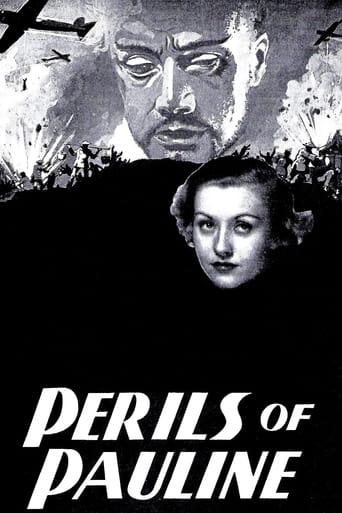
Perils of Pauline (1933)
A famous scientist and his beautiful daughter travel to Indochina to find an ivory disc that has the formula for a deadly gas engraved on it. An evil doctor and his gang are also looking for it.
- Date of release
- 1933-11-05
- TMDB
- 6.5 / 10 (4)
- Runtime
- 3h 51m
- Genres
- Action, Adventure
- Director
- Ray Taylor
Casting
- Evalyn Knapp — Pauline Hargrave
- Craig Reynolds — Robert Ward (as Robert Allen)
- James Durkin — Prof. Hargrave
- John Davidson — Dr. Bashan
- Sonny Ray — Willie Dodge
- Frank Lackteen — Fang
- Pat O'Malley — Tim Sullivan
- William Desmond — Prof. Thompson
- Josef Swickard — Haggins, Foreign Consul
- William Worthington — American Consul
- Adolph Milar — Capt. Drake
- James Wang — Foo Chow, Bashan's Henchman
Interesting facts
The Perils of Pauline is a 1933 American pre-Code film serial, and sound film remake, of the Pathé original. The 12-chapter "cliffhanger" was produced by Universal Studios. Evalyn Knapp, herself a graduate of Pathé silent short subjects, starred as the heroine, Pauline Hargraves. Historic newsreel footage of the 1930 flight of the Dornier Do X seaplane is featured in chapter eight.
Production
The storyline of the 1914 The Perils of Pauline involved a young woman who inherited a million dollars from a distant relative. Her relative's personal secretary was named guardian of the funds, and would inherit if she died before she remarried. Determined to enjoy some adventures before marrying, Pauline sets off around the world—only to have her guardian, Mr. Koerner, attempt to murder her several times.
In September 1930, Pathé said it would remake The Perils of Pauline. But no action was taken. Universal announced it would remake the serial in July 1932. It purchased the talking picture rights from Pathé, and the media speculated that Lucile Browne would take the title role. In March 1933, the studio said production would begin in July.
Filming began on the serial in the middle of August 1933. Universal announced that Ray Taylor was directing, and Evalyn Knapp was starring. The original screenplay had each episode set in a different country, although this clearly changed by the time the film was finished. The young actor Hugh Enfield was originally cast in the role of Robert Warde.
Production costs for the film are not known. However, The New York Times said in 1936 that Universal usually paid $3,000 to $17,000 for a good character, gave its stars $1,000 to $5,000 per week, spent six to eight weeks shooting each serial, and spent $165,000 to $250,000 per serial.
The first episode of the serial was released on November 6, 1933.
Read on Wikipedia · Text from Wikipedia, CC BY-SA 4.0. Data from Wikidata.
Recommended
- MacGyver: Trail to Doomsday 1994 · ★ 6.0
- Jack Hunter and the Quest for Akhenaten's Tomb 2008 · ★ 6.2
- Jungle Run 2021 · ★ 5.9
- Jack Hunter and the Star of Heaven 2009 · ★ 6.4
- Babylon 5: The Legend of the Rangers - To Live and Die in Starlight 2002 · ★ 6.0
- The Lost Princess 2025 · ★ 6.3
- No Retreat, No Surrender 2: Raging Thunder 1987 · ★ 6.0
- Street Fighter: Assassin's Fist The Movie 2014 · ★ 7.2
- River Wild 2023 · ★ 6.4
- Interceptor 2022 · ★ 6.0
- Airborne 1993 · ★ 6.1
- Halo: Nightfall 2014 · ★ 6.8