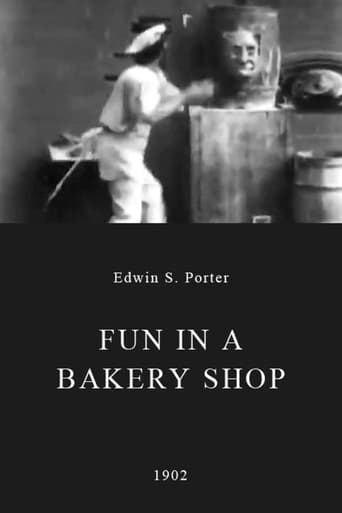
Fun in a Bakery Shop (1902)
A baker's assistant throws a handful of dough at a rat. The dough sticks to the side of a barrel and the assistant proceeds to sculpt the dough into various faces and shapes. There is some experimental use of stop motion.
- Date of release
- 1902-04-03
- TMDB
- 5.5 / 10 (16)
- Runtime
- 2m
- Genres
- Comedy
- Director
- Edwin S. Porter
Interesting facts
Fun in a Bakery Shop is a 1902 American short film by Edwin S. Porter. Porter used stop-motion animation to depict clay loaves being sculpted into faces. The film was released on April 3, 1902, by the Edison Manufacturing Company. The film's plot was only the pretext of showcasing the skills of a fast sculptor.
Production
In 1897, plasticine was invented in the United Kingdom. The inventor William Harbutt published a book called Harbutt's Method and Use of Plasticine in the Arts of Writing, Drawing and Modelling in Educational Work, with the intention of providing methods for using plasticine in educational contexts. The book also provided the methods which were used in the animation of clay, claymation.
Several early trick films used the concept of the "lightning cartoonists", while Fun in a Bakery Shop introduced the concept of the "lightning sculptor". While not seen as an actual example of claymation, it paved the way for the use of clay animation in two 1908 film adaptations of the works of Winsor McCay (A Sculptor's Welsh Rabbit Dream and The Sculptor's Nightmare).
Read on Wikipedia · Text from Wikipedia, CC BY-SA 4.0. Data from Wikidata.
Recommended
- Dough and Dynamite 1914 · ★ 6.1
- Beau Hunks 1931 · ★ 6.8
- Ferdinand the Bull 1938 · ★ 6.7
- Mike's New Car 2002 · ★ 6.9
- Banana 2010 · ★ 7.1
- A Woman 1915 · ★ 6.1
- The Bank 1915 · ★ 6.3
- The Tramp 1915 · ★ 6.5
- Shaun the Sheep: The Farmer's Llamas 2015 · ★ 6.6
- Perfect Day 1929 · ★ 7.0
- Mickey's Steam Roller 1934 · ★ 6.4
- Marvel One-Shot: All Hail the King 2014 · ★ 6.8