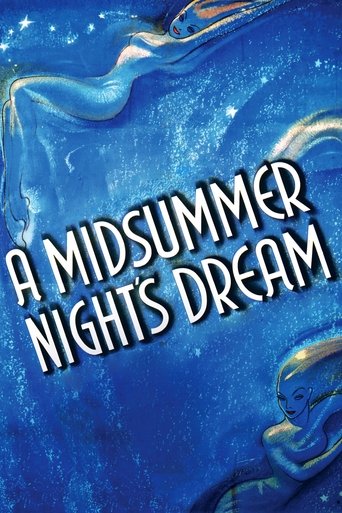
A Midsummer Night's Dream (1935)
Three Centuries In The Making! An immortal literary classic becomes a triumph of the ages!
Mistaken identity, unrequited love, and the supernatural are combined in Shakespeare's classic set in the woods of Greece on a moonlit night.
- Date of release
- 1935-10-09
- TMDB
- 6.4 / 10 (53)
- Runtime
- 2h 23m
- Genres
- Fantasy, Romance, Comedy
- Director
- Max Reinhardt, William Dieterle
Casting
- Ian Hunter — Theseus
- Verree Teasdale — Hippolyta
- Hobart Cavanaugh — Philostrate
- Dick Powell — Lysander
- Ross Alexander — Demetrius
- Olivia de Havilland — Hermia
- Jean Muir — Helena
- Grant Mitchell — Egeus
- Frank McHugh — Quince
- Dewey Robinson — Snug
- James Cagney — Bottom
- Joe E. Brown — Flute
Interesting facts
- Based on: A Midsummer Night's Dream
- Awards: 2 · Nominations: 3. Including: Academy Award for Best Cinematography; Academy Award for Best Film Editing
A Midsummer Night's Dream is a 1935 American romantic comedy film adaptation of the Shakespearean play of the same name. It is directed by Max Reinhardt and William Dieterle, produced by Warner Bros. Pictures, and stars James Cagney, Mickey Rooney, Olivia de Havilland, Jean Muir, Joe E. Brown, Dick Powell, Ross Alexander, Anita Louise, Victor Jory and Ian Hunter. The screenplay, written by Charles Kenyon and Mary C. McCall Jr., is adapted from Reinhardt's Hollywood Bowl production of the play from the previous year.
Production
Many of the actors in this version never had performed Shakespeare and would not do so again, especially Cagney and Brown, who were nevertheless highly acclaimed for their performances. Many critics agreed that Dick Powell was miscast as Lysander, and Powell concurred with the critics' verdict.
Although the cast of the stage play was mostly replaced by Warner Brothers contract players, de Havilland and Mickey Rooney were chosen to reprise their original roles. This was de Havilland's motion picture debut.
Avant-garde director Kenneth Anger claimed in his book Hollywood Babylon II to have played the changeling prince in this film when he was a child, but in fact the role was played by child actress Sheila Brown.
Max Reinhardt did not speak English at the time of the film's production. He instead gave orders to the actors and crew in Austrian German while fellow refugee and longtime Reinhardt collaborator William Dieterle acted as his interpreter.
The shooting schedule had to be rearranged after Mickey Rooney broke his leg while tobogganing at Big Pines, California. Since the production was too expensive to be delayed, Rooney's remaining scenes had to be shot with a stand-in, George Breakston, for the running and elfin sequences. Foliage had to be used to conceal his broken leg, as well as holes in the floor to complete Rooney's scenes. According to Rooney's memoirs, Jack L.
Read on Wikipedia · Text from Wikipedia, CC BY-SA 4.0. Data from Wikidata.
Recommended
- Penelope 2006 · ★ 6.7
- Corpse Bride 2005 · ★ 7.6
- Ladyhawke 1985 · ★ 7.0
- Shrek the Musical 2013 · ★ 7.1
- Thumbelina 1994 · ★ 6.5
- Blithe Spirit 1945 · ★ 6.9
- Prince Charming 2001 · ★ 6.9
- The Right Kind of Wrong 2013 · ★ 5.9
- I Do, I Do, I Do 2015 · ★ 6.2
- The Gnome-Mobile 1967 · ★ 6.3
- What's Love Got to Do with It? 2023 · ★ 6.1
- Marry Me 2022 · ★ 6.6