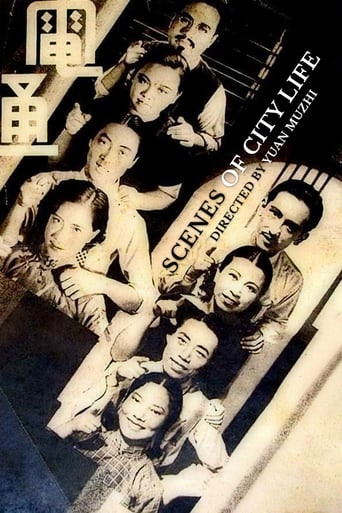
Scenes of City Life (1935)
都市風光
A novelist uses all his money to buy gifts for the woman he loves who in turn is also seeing a business man, using him for expensive presents. As a consequence the writer is unable to pay the rent, whilst the womans family goes hungry as her fathers business suffers. A joyful comedy that expresses the dangers of consumerism for the careless spender.
- Date of release
- 1935-05-13
- TMDB
- 6.3 / 10 (3)
- Runtime
- 1h 39m
- Genres
- Comedy, Drama
- Director
- Muzhi Yuan
Casting
- Xinzhu Zhang — Xiaoyun
- Na Tang — Menghua Li
- Boxun Zhou — Xiaoyun's father
- Wu Yin — Yunmu Xiao
- Menghe Gu — Junsan Wang
- Ruohong Cai — Secretary Chen
- Lu Bai — Girl
- Qing Jiang — girlfriend
- Muzhi Yuan — salesman
- Sizhi Feng — cashier
- Bozi Fan — stationmaster
- Shichuan Zhang — comprador
Interesting facts
Scenes of City Life is a 1935 Chinese comedy-drama film directed by Yuan Muzhi. It is also translated as Cityscape. It is noted for being the first film directed by Yuan, as well as the first film appearance of Jiang Qing, who later became Mao Zedong's fourth wife. This film belongs to the type of film in which many members of music related professionals were prominent, these were works where music is a key aspect of framing within the film.
Production
Regarded as the first musical comedy in the history of Chinese cinema, Scenes of City Life was the first Chinese film with its own music that were specifically written for the film through a three-way cooperation of three eminent composers: Yuanren Zhao, Zi Huang and Lüting He.
The film studio Diantong was originally a sound equipment company established in 1933 by 3 electrical engineers: Ma Dejian, Situ Huimin, and Gong Yuke. Together, they invented one of the earliest sound-on-film recording systems in China: the Sanyou-style recording system (Sanyoushi luyingji). This system is later used in films such as The Big Road (1934), Song of the Fishermen (1934), and Scenes of City Life.
In 1934, Diantong changed into a film studio, competing with other studios such as Mingxing and Lianhua. The studio attracted relatively young artists who were particularly active in spoken drama. The Director Yuan Muzhi wrote the story of Scenes of City Life in 1934 as a literary piece. After less than 2 years, the studio was forced to shut down for economic and political reasons.
Despite its comedic and musical elements, the film presents a satire on the socio-economic conditions of Shanghai in the 1930s. It demonstrates leftist agenda through the struggles in a rapidly modernizing urban environment and subtly hinting collective action as the solution.
Chinese film makers in the 1930s, including the cast of Scenes of City Life, faced severe financial difficulties, struggled with low wages and unstable employment. Many filmmakers lived in cramped quarters like tingzijian. Although these environments were unpleasant and ill to live in, it did aid in fostering a creative and collaborative atmosphere which influenced their cinematic techniques: strong sensitivity to space and acoustic.
Read on Wikipedia · Text from Wikipedia, CC BY-SA 4.0. Data from Wikidata.
Recommended
- Landline 2017 · ★ 6.2
- SubUrbia 1997 · ★ 6.2
- Somewhere in Queens 2023 · ★ 6.3
- I Am Not Madame Bovary 2016 · ★ 6.8
- Big Shot's Funeral 2001 · ★ 6.6
- CQ 2001 · ★ 5.9
- Lady Windermere's Fan 1925 · ★ 6.9
- Hooking Up 2020 · ★ 6.3
- About Alex 2014 · ★ 6.1
- Cook Up a Storm 2017 · ★ 7.5
- It Runs in the Family 2003 · ★ 6.0
- Young Adult 2011 · ★ 5.8