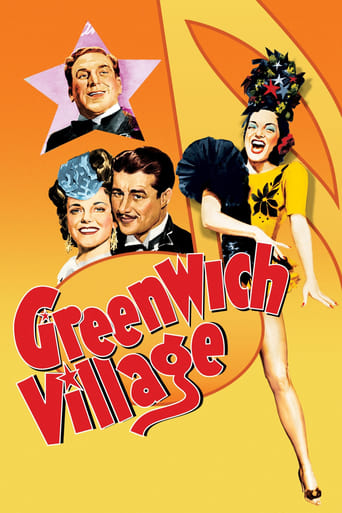
Greenwich Village (1944)
In 1922, a would-be classical composer gets involved with people putting on a musical revue.
- Erscheinungsdatum
- 1944-09-27
- TMDB
- 6.7 / 10 (6)
- Laufzeit
- 1 Std. 22 Min.
- Genres
- Komödie, Musik
- Regie
- Walter Lang
Besetzung
- Carmen Miranda — Princess Querida O'Toole
- Don Ameche — Kenneth Harvey
- William Bendix — Danny O'Mara
- Vivian Blaine — Bonnie Watson
- Felix Bressart — Hofer
- Tony De Marco — Tony
- Sally De Marco — Sally
- B.S. Pully — Brophy
- Emil Rameau — Kavosky
- Judy Holliday — Revuer (Uncredited)
- Frank Orth — Ordway
- Torben Meyer — Butler
Wissenswertes
Greenwich Village is a 1944 American comedy-drama musical film from Twentieth Century Fox directed by Walter Lang. It stars Carmen Miranda and Don Ameche.
Production
Information in the Twentieth Century-Fox Produced Scripts Collection, located at the UCLA Arts, indicates that Robert Ellis, Helen Logan and Valentine Davies worked on early versions of the screenplay for this picture. Their contribution to the completed film is doubtful, however.
According to news published by The Hollywood Reporter on 29 October 1942, Alice Faye and Phil Regan were originally scheduled to star in the picture. Other actors announced by The Hollywood Reporter as having been cast included Ronald Graham, Jack Oakie (who was to play "Danny O'Mara" according to studio records), Phil Baker and Perry Como (who was to make his debut in the picture).
In July 1943, The Hollywood Reporter also reported that Lillian Porter had been cast in the film, but her appearance in the completed picture has not been confirmed. Although the onscreen credits introduce actress Vivian Blaine "in Her First Featured Role," Blaine had appeared in several previous productions for Twentieth Century-Fox, including a starring role in the 1943 film Jitterbugs.
The picture marked the screen debut of The Revuers, a cabaret group featuring Judy Holliday (who is billed as Judith Tuvim on the CBCS), Betty Comden, Adolph Green and Alvin Hammer. Although news published by The Hollywood Reporter indicated that The Revuers' "satiric sketch of a Shubert operetta" had been purchased by the studio for their debut, the sequence was cut from the finished picture, and modern sources note that the group appears only i…
According to information in the film's file in the MPAA/PCA Collection at the AMPAS Library, the Production Code Administration initially rejected the screenplay due to "sustained scenes of excessive and unnecessary drinking and drunkenness." The romantic leads even humorously break the code rule of unintentionally sharing a bed on screen - albeit fully clothed and hungover.
Auf Wikipedia weiterlesen · Text aus Wikipedia, CC BY-SA 4.0. Daten aus Wikidata.
Empfohlen
- Parade im Rampenlicht 1933 · ★ 6.8
- Die tollkühne Rettung der Gangsterbraut Honey Swanson 1948 · ★ 6.5
- Soul Men 2008 · ★ 6.2
- Die Marx Brothers im Kaufhaus 1941 · ★ 6.3
- Bo Burnham: Make Happy 2016 · ★ 8.0
- The After Party 2018 · ★ 6.1
- A Mighty Wind 2003 · ★ 6.8
- Get Crazy 1983 · ★ 6.3
- Bo Burnham: What. 2013 · ★ 7.8
- Adam Sandler: 100% Fresh 2018 · ★ 7.1
- Die Marx Brothers im Theater 1949 · ★ 5.8
- Bo Burnham: Words, Words, Words 2010 · ★ 7.3