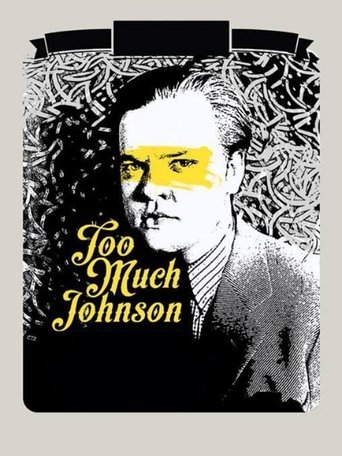
Too Much Johnson (2013)
This film was not intended to stand by itself, but was designed as the cinematic aspect of Welles' Mercury Theatre stage presentation of William Gillette's 1894 comedy about a New York playboy who flees from the violent husband of his mistress and borrows the identity of a plantation owner in Cuba who is expecting the arrival of a mail order bride. The film component of the performance was ultimately never screened due to the absence of projection facilities at the venue. Long-believed to be lost, a workprint was discovered in 2008 and the film had its premiere in 2013.
- Date of release
- 2013-10-09
- TMDB
- 5.4 / 10 (29)
- Runtime
- 1h 7m
- Genres
- Comedy
- Director
- Orson Welles
Casting
- Joseph Cotten — Augustus Billings (uncredited)
- Virginia Nicolson — Lenore Faddish (uncredited)
- Arlene Francis — Mrs. Dathis (uncredited)
- Mary Wickes — Mrs. Battison (uncredited)
- Orson Welles — Keystone Kop (uncredited)
- John Houseman — Duelist (uncredited)
- Edgar Barrier — Leon Dathis (uncredited)
- Ruth Ford — Mrs. Billings (uncredited)
- Eustace Wyatt — Francis Faddish (uncredited)
- Guy Kingsley Poynter — Henry MacIntosh (uncredited)
- George Duthie — Purser (uncredited)
- Herbert Drake — Keystone Kop (uncredited)
Interesting facts
- Filmed in: New York City
Too Much Johnson is a 1938 American silent comedy film written and directed by Orson Welles. An unfinished film component of a stage production, it was made three years before Welles directed Citizen Kane, but it was never publicly screened. It was shot to be integrated into Welles's Mercury Theatre stage presentation of William Gillette's 1894 comedy, but the film sequences could not be shown due to the absence of projection facilities at the venue, the Stony Creek Theatre in Connecticut. The resulting plot confusion reportedly contributed to the stage production's failure.
Production
The film was not intended to stand by itself, but was designed as the cinematic aspect of Welles's Mercury Theatre stage presentation of William Gillette's 1894 comedy about a New York playboy who flees from the violent husband of his mistress and borrows the identity of a plantation owner in Cuba who is expecting the arrival of a mail-order bride.
Welles planned to mix live action and film for this production. The film was designed to run 40 minutes, with 20 minutes devoted to the play's prologue and two 10-minute introductions for the second and third act. Welles planned to create a silent film in the tradition of the Mack Sennett slapstick comedies, in order to enhance the various chases, duels and comic conflicts of the Gillette play.
"The multi-media concept was a throwback to the early age of cinema when vaudeville shows were punctuated by quick cinematic vignettes," wrote Welles biographer Bret Wood. The alternation format stage-and-screen hybrid—scenes of live performance linked together by film segments—dates back to 1896.
Welles thought highly of Joseph Cotten as a comic actor, and cast him as the lead in the farce. Other Mercury Theatre actors included Ruth Ford, Arlene Francis, Howard Smith, Mary Wickes and Eustace Wyatt. Welles's wife, Virginia Nicolson, appeared in the film under her professional pseudonym Anna Stafford.
Harry Dunham, a newsreel and documentary cameraman who was an old friend of Paul Bowles, was the film's cinematographer. Location photography took place in New York City's Battery Park and Central Park. Additional shooting took place on a Hudson River day-trip excursion boat and at locations in Yonkers, New York, and Haverstraw, New York. Interior shots were set up at a studio in the Bronx, New York.
Read on Wikipedia · Text from Wikipedia, CC BY-SA 4.0. Data from Wikidata.
Recommended
- The Railrodder 1965 · ★ 6.8
- The Bank 1915 · ★ 6.3
- The Tramp 1915 · ★ 6.5
- The Ladies Man 1961 · ★ 6.3
- The Fireman 1916 · ★ 6.3
- A Burlesque on Carmen 1915 · ★ 5.8
- How to Irritate People 1969 · ★ 6.6
- A Woman 1915 · ★ 6.1
- Eddie Murphy Raw 1987 · ★ 7.2
- Brain Donors 1992 · ★ 6.1
- Fun with Dick and Jane 1977 · ★ 6.6
- My Wife's Relations 1922 · ★ 6.2