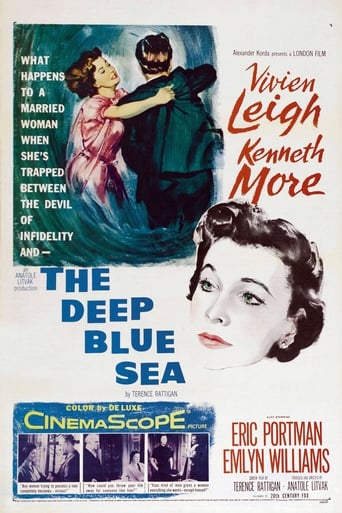
Marea adâncă și albastră (1955)
The Deep Blue Sea
A woman is unhappy in her marriage to a boring, stiff judge, so she takes up with a wild-living RAF pilot, who ends up being more than she can handle.
- Data lansării
- 1955-10-03
- TMDB
- 4.9 / 10 (14)
- Durată
- 1 h 40 min
- Genuri
- Dramă, Romantic
- Regizor
- Anatole Litvak
Distribuție
- Vivien Leigh — Hester Collyer
- Kenneth More — Freddie Page
- Eric Portman — Miller
- Emlyn Williams — Sir William Collyer
- Moira Lister — Dawn Maxwell
- Arthur Hill — Jackie Jackson
- Dandy Nichols — Mrs. Elton
- Alec McCowen — Ken Thompson
- Jimmy Hanley — Dicer Durston
- Heather Thatcher — Lady Dawson
- Bill Shine — Golfer
- Brian Oulton — Drunk
Curiozități
The Deep Blue Sea is a 1955 British drama film directed by Anatole Litvak, starring Vivien Leigh and Kenneth More, and produced by London Films and released by Twentieth Century Fox. It was written by Terence Rattigan based on his 1952 play of the same name.
Development
The play had been very successful and a number of companies expressed interest in obtaining the film rights. Alexander Korda offered £40,000 plus £10,000 to write the screenplay. He intended for Anatole Litvak to direct and Olivia de Havilland to star as Hesther. However, negotiations stalled when 20th Century Fox refused to let Litvak direct the film.
Some time later, Korda approached Rattigan again and he bought the screen rights for £7,500, plus £4,000 to Rattigan to write the script. Korda wanted Vivien Leigh to play Hesther, Kenneth More to play Freddie, and Charles Boyer to play Mr Miller, but said Leigh would not accept Rattigan's preferred director, Anthony Asquith. Rattigan started working on the script after the premiere of Separate Tables.
Kenneth More was the only key member of the original cast (who had also appeared in a BBC Television version in 1954) to be hired for the film, as Alexander Korda wanted to use names that were more recognisable to movie-goers. (More had just been put under contract to Korda.) More always felt this was a mistake, particularly the casting of Vivien Leigh rather than Peggy Ashcroft. He later wrote:
The casting of the beautiful Vivien Leigh was absurd. She was supposed to be an outwardly ordinary but secretly highly-sexed woman who meets a young pilot on the golf course and falls for him. My first lines on meeting her were to say: 'My God, Hes, you're beautiful.' She had never been told this before – and understandably it had a remarkable effect on her.
More did not enjoy filming, feeling that the use of CinemaScope and changes made to the original play detracted from the intimacy of the story. He also felt he had poor chemistry with Leigh. "We were never in complete accord," wrote More. "I thought her interpretation was wrong, and so when we played a scene together we had the wrong chemistry between us."
Citește pe Wikipedia · Text din Wikipedia, CC BY-SA 4.0. Date din Wikidata.
Recomandate
- Eram străini când ne-am întâlnit 1960 · ★ 6.4
- Chipuri 1968 · ★ 7.1
- Infidela 2002 · ★ 6.7
- Adulterers 2016 · ★ 6.2
- Middle of the Night 1959 · ★ 7.0
- Persuasion 1995 · ★ 7.2
- Not Easily Broken 2009 · ★ 6.3
- Știri de acasă 2001 · ★ 6.4
- Albatross 2011 · ★ 6.0
- Mama 2003 · ★ 6.0
- Departe de câmpia în flăcări 2008 · ★ 6.6
- Materialiștii 2025 · ★ 6.2