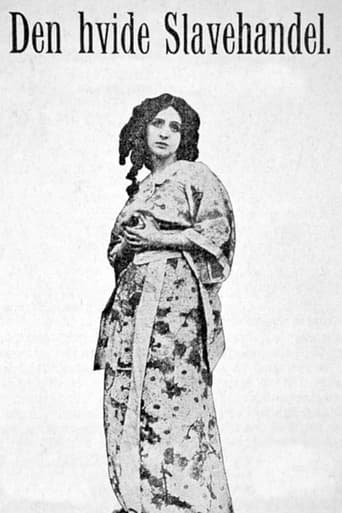
The White Slave Trade (1910)
Den hvide slavehandel
Anna, a beautiful girl from a poor background, is offered a well-paid position as a lady's companion in London. Anna's boyfriend, the sceptical Georg, suspects that the job offer is too good to be true, but Anna dismisses him and reports to the London address. The stately home in England turns out to be a whorehouse that imports women from Denmark. Anna manages to overpower her first client but is unable to escape.
- Date of release
- 1910-08-02
- TMDB
- 5.6 / 10 (16)
- Runtime
- 33m
- Genres
- Drama
- Director
- August Blom
Casting
- Ellen Diedrich — Anna
- Victor Fabian
- Julie Henriksen — Annas Mom
- Rigmor Jerichau
- Ella La Cour — Bordelvaertinde
- Otto Lagoni — Annas Dad
- Doris Langkilde
- Aage Lorentzen
- Lauritz Olsen — Georg
- Einar Zangenberg
Interesting facts
The White Slave Trade is a 1910 Danish silent drama film directed by August Blom. It is the only August Blom movie from 1910 that has been preserved. The film produced by Nordisk Films was the company's first feature film and became a major sales success, 103 copies being sold world-wide. However the film could not be released in the United States of America because of censorship. The film was a remake of an eponymous film by competing producer Fotorama, which is considered lost.
Production and reception
In 1910, filmmaker Ole Olsen, who had established in 1910 Nordisk Films Kompagni, the oldest Danish film production, hired actor August Blom as its new Head of Production. Between 1910 and 1925, he directed more than 100 films and started a new genre, the erotic melodrama. The White Slave Trade was his third film and it was a remake a film with the same title released in the Spring of 1910 by Nordisk Film's main competitor: Fotorama.
To bank on this success, Olsen asked Blom to watch carefully the Fotorama film and to make a scene-by-scene re-creation of it. This was done, except for a few roles that got a name change. Nordisk did not hide its plagiarism, boasting that the film was executed exactly in the same way as the Fotorama film, but performed by better artists. This was not illegal because the Danish law on copyright did not cover films at the time.
When Nordisk, in line with it usual practice, decided to distribute the film outside of Denmark, notably in Germany, he faced initially the reluctance of German distributors to present a film with of such a long duration, the standard for films being at the time one reel of about 15 minutes. Ole Olsen threatened a Hamburg cinema owner to stop supplying any Nordisk production to him if he did not program The White Slave Trade.
Given the success of the film, Nordisk produced two sequels, Den hvide slavehandel II (In the Hands of Impostors) in 1911 and Den hvide slavehandel III (The White Slave Trade III) in 1912.
Read on Wikipedia · Text from Wikipedia, CC BY-SA 4.0. Data from Wikidata.
Recommended
- The Inheritance 2003 · ★ 6.4
- What Maisie Knew 2013 · ★ 7.1
- Hungry Hearts 2015 · ★ 6.5
- Herself 2020 · ★ 6.7
- The Girl in the Book 2015 · ★ 5.8
- Hardball 2001 · ★ 6.5
- Pimp 2018 · ★ 6.2
- Girl in the Box 2016 · ★ 6.7
- Gracie 2007 · ★ 6.2
- Lorelei 2020 · ★ 6.0
- The Sound of Silence 2019 · ★ 5.9
- The Nest 2020 · ★ 6.1