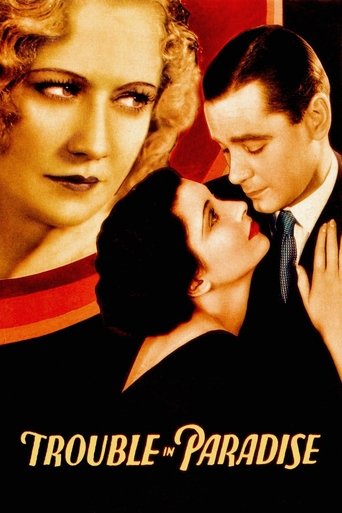
Trouble in Paradise (1932)
HIS PARADISE BECAME A MERRY HELL!
Thief Gaston Monescu and pickpocket Lily are partners in crime and love. Working for perfume company executive Mariette Colet, the two crooks decide to combine their criminal talents to rob their employer. Under the alias of Monsieur Laval, Gaston uses his position as Mariette's personal secretary to become closer to her. However, he takes things too far when he actually falls in love with Mariette, and has to choose between her and Lily.
- Date of release
- 1932-10-30
- TMDB
- 7.4 / 10 (329)
- Runtime
- 1h 23m
- Genres
- Comedy, Crime, Romance
- Director
- Ernst Lubitsch
Casting
- Miriam Hopkins — Lily
- Kay Francis — Mariette
- Herbert Marshall — Gaston
- Charles Ruggles — Major
- Edward Everett Horton — Francois
- C. Aubrey Smith — Giron
- Robert Greig — Jacques
- Luis Alberni — Annoyed Opera Fan (uncredited)
- Hooper Atchley — Insurance Agent (uncredited)
- Tyler Brooke — Commercial Singer (uncredited)
- Marion Byron — Maid (uncredited)
- Louise Carter — Woman with Wrong Handbag (uncredited)
Interesting facts
- Box office: $475K
- Budget: $519.7K
- Earned 0.9× its budget
- Awards: 1 · Nominations: 0. Including: National Board of Review: Top Ten Films
Trouble in Paradise is a 1932 American pre-Code romantic comedy film produced and directed by Ernst Lubitsch and starring Miriam Hopkins, Kay Francis, and Herbert Marshall. Based on the 1931 play The Honest Finder by Hungarian playwright Aladár László, the lead characters are a gentleman thief and a lady pickpocket who join forces to con a beautiful woman who is the owner of a perfume company. In 1991, Trouble in Paradise was selected for preservation by the United States National Film Registry by the Library of Congress as being "culturally, historically, or aesthetically significant".
Production
Working titles for Trouble in Paradise included The Honest Finder, Thieves and Lovers, and The Golden Widow; the latter was publicly announced to be the intended release title. As with all the Lubitsch-Raphaelson collaborations, Lubitsch contributed to the writing and Raphaelson contributed ideas to the directing.
Made before effective enforcement of the Production Code, the film is an example of pre-Code cinema containing adult themes and sexual innuendo that was not permitted under the Code. In 1935, when the Production Code was being enforced, the film was not approved for reissue, and it was not seen again until 1968. Paramount was again rejected in 1943, when the studio wanted to make a musical version of the film.
The Art Deco sets for Trouble in Paradise were designed by the head of Paramount's art department, Hans Dreier, and the gowns were designed by Travis Banton.
Read on Wikipedia · Text from Wikipedia, CC BY-SA 4.0. Data from Wikidata.
Recommended
- Take the Money and Run 1969 · ★ 7.1
- Avanti! 1972 · ★ 6.9
- A Good Woman 2004 · ★ 6.3
- Heartbreakers 2001 · ★ 6.2
- Saving Silverman 2001 · ★ 5.8
- Only You 1994 · ★ 6.7
- I Love You to Death 1990 · ★ 6.4
- Fun with Dick and Jane 1977 · ★ 6.6
- Beat the Devil 1953 · ★ 6.1
- Jingle Bell Heist 2025 · ★ 6.1
- You, Me & Tuscany 2026 · ★ 7.3
- Excess Baggage 1997 · ★ 6.1