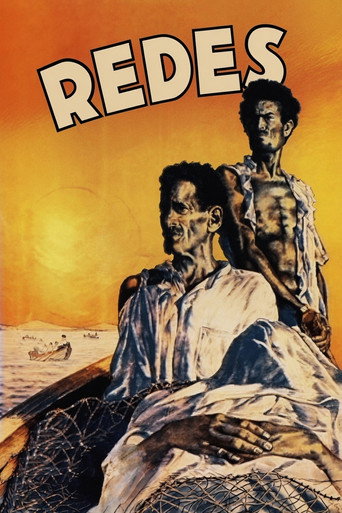
The Wave (1936)
Redes
A Mexican fisherman, whose son has died because he could not afford necessary medical care out of his meagre wages, becomes aware of how badly exploited he and his many fellow fisherman are by the one greedy man for whom they work and the corrupt politician who makes the laws to benefit him.
- Date of release
- 1936-07-16
- TMDB
- 6.4 / 10 (26)
- Runtime
- 1h 1m
- Genres
- Drama
- Director
- Fred Zinnemann, Emilio Gómez Muriel
Casting
- Silvio Hernández — Miro
- Antonio Lara — El Zurdo
- Miguel Figueroa — Miguel
- Rafael Hinojosa — El Candidato
- Felipe Rojas — Mingo
- David Valle González — Don Anselmo
- Susana Ortiz Cobos — Miro's Wife
Interesting facts
Redes is a Mexican film, released in 1936, about the fishing community of Alvarado on the Gulf Coast of Mexico, near the city of Veracruz. The film's title comes from the Spanish word redes ("nets") in reference to fishing nets. The English-language edition's title is The Wave. Redes was made with a mainly non-professional cast and has been seen as anticipating Italian neorealism. It concerns the struggle of poor fishermen to overcome exploitation. The film was directed by Fred Zinnemann and Emilio Gómez Muriel who were both also among the co-writers.
Production
Paul Strand began work on the project, which was originally conceived as a documentary, in 1933. He had come to Mexico at the invitation of the Mexican composer Carlos Chávez, who had a government job promoting the arts under the socialist education minister Narciso Bassols. The film developed into a work of fiction with a scenario by Strand and Agustín Chávez, nephew of the composer.
Towards the end of 1933, Henwar Rodakiewicz, a friend of Strand's from the Camera Club of New York, arrived to assist in the production. Rodakiewicz determined that the scenario was ragged and incoherent. Before returning to the US for a few months, he wrote a shooting script for the film and made arrangements for his friend, Fred Zinnemann, to travel to Alvarado to take on the role of director.
Strand had left-wing views and was influenced by Eisenstein (whose Battleship Potemkin includes imagery of waves). Zinnemann cited Robert Flaherty as an influence.
The production was affected by political developments in 1934. Bassols resigned as minister of education in May and Carlos Chávez was replaced. Work on Redes continued under Chávez' successor, Antonio Castro Leal. However, Strand was warned that funding could not be guaranteed beyond the end of the year, when a new president was due to take office. He left Mexico early in 1935 with the film still unreleased.
Read on Wikipedia · Text from Wikipedia, CC BY-SA 4.0. Data from Wikidata.
Recommended
- The Old Man and the Sea 1958 · ★ 6.5
- Erin Brockovich 2000 · ★ 7.4
- Captains Courageous 1937 · ★ 7.4
- The Tree 2010 · ★ 6.4
- On the Fringe 2022 · ★ 6.6
- Hurry Sundown 1967 · ★ 6.4
- Good Day, Ramon 2013 · ★ 7.9
- The Truth About Emanuel 2013 · ★ 6.0
- The River 1984 · ★ 6.4
- The Miracle of Marcelino 1955 · ★ 7.4
- Blue Miracle 2021 · ★ 7.3
- Jeopardy 1953 · ★ 6.8