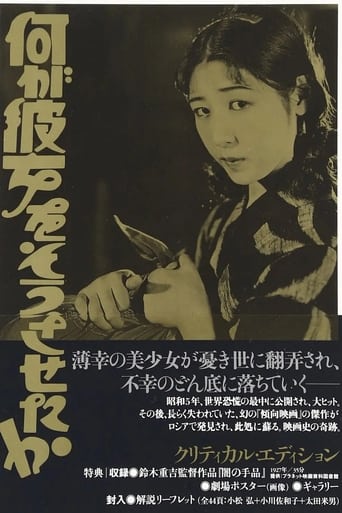
Что заставило её это сделать? (1930)
何が彼女をそうさせたか
Юная Сумико Накамура отправляется в одинокое путешествие, когда отец решает, что его дочери лучше жить с его братом и её дядей. Поездка начинается в поезде, но далее она идёт пешком и на телеге, когда незнакомец подвозит её. Увы, но приехав к своему дяде девушка не встречает ни радости, ни сострадания, ни доброты, так как в этом доме она нежданная и ненужная. Вскоре её продают в рабство. Мир юной девушки и её жизнь движутся по спирали вниз, когда она начинает понимать, что не может полагаться на семью, людей или бога и ожидать от них помощи.
В ролях
- 高津慶子 — Sumiko Nakamura
- Tamako Nijô — Hideko Akiyama / Prefectural assemblywoman
- Chieko Sono — Osada, wife of Yamada
- Shizuko Ozaki — Umeko Yazawa
- Eiko Aida — Okaku Shimamura
- 藤間林太郎 — Akimitsu Hasegawa
- 浜田格 — Tetsuzo Ogawa, circus manager
- 小島洋々 — Sahei Sakamoto
- Takashi Asano — Kanta Yamada / Sumiko's uncle
- Saburô Oono — Yamashita / Police Sergeant
- Kangyô Nakamura — Master of pawnshop
- Hidekatsu Maki — Hara
Интересные факты
What Made Her Do It? is a 1930 Japanese silent film directed by Shigeyoshi Suzuki. It was the top-grossing Japanese film of the silent era. Notable as an example of the tendency film genre, it reportedly caused a riot upon its showing in Tokyo's Asakusa district.
Production and reception
After the commercial success of other tendency films such as Tomu Uchida's A Living Puppet and Kenji Mizoguchi's Metropolitan Symphony (both 1929), produced by the Nikkatsu studio, the entertainment-oriented Teikine (Teikoku Kinema Engei) studio produced What Made Her Do It?, introducing "vulgar elements" (Geoffrey Nowell-Smith) aimed at the audience to the story, thus lightening its social criticism.
In his 2005 book A Hundred Years of Japanese Film, film historian Donald Richie titled the film "a melodramatic potboiler", at the same time acknowledging it for being "also extraordinarily film literate". The British Film Institute listed What Made Her Do It? as the best Japanese film of 1930, considering it to be representative of the period's tendency films.
Читать в Википедии · Текст из Википедии, CC BY-SA 4.0. Данные Викиданных.
Рекомендуем
- Короли Шарм-Сити 2020 · ★ 7.8
- Скорпион: Песня ненависти №701 1973 · ★ 6.1
- Мост 2003 · ★ 7.3
- Хардбол 2001 · ★ 6.5
- Skin 2009 · ★ 6.4
- Лорелея 2020 · ★ 6.0
- Развод в большом городе 2013 · ★ 7.1
- The Young One 1960 · ★ 7.0
- Легенда о Нараяме 1983 · ★ 7.5
- Гнездо 2020 · ★ 6.1
- Дом на Кэрролл-стрит 1988 · ★ 5.9
- Реальная любовь в Нью-Йорке 2019 · ★ 6.4