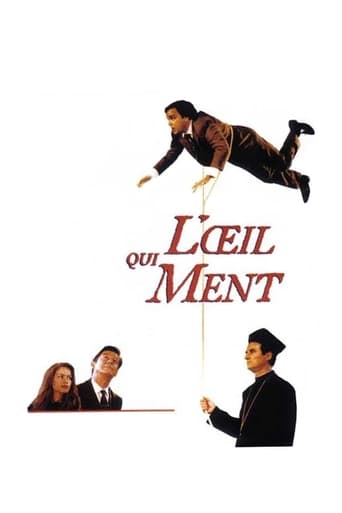
Dark at Noon (1992)
L’œil qui ment
In this mystical comedy, Felicien has traveled to Portugal from France soon after the end of the First World War. It seems that his recently deceased father had invested a lot of money in a factory located in a remote village, and he has come to evaluate that investment. He gets some clues to the real situation in the town when the man driving his coach refuses to go any further and leaves him on a section of road which is practically paved with abandoned crutches. After a short trek, he meets up with the local dignitary who is to show him around, and he meets a priest and an artist. The priest gives a further clue to the events taking place in the village when he indicates that he's completely exasperated with the endless miracles that seem to be taking place. From that point onward, amazing coincidences, visions and miracles take place in great numbers.
Casting
- John Hurt — Anthony / Le Marquis
- Didier Bourdon — Docteur Felicien
- Lorraine Evanoff — Ines
- David Warner — Ellic
- Daniel Prévost — Le curé
- Myriem Roussel — La vierge des imitations
- Felipe Dias — L'enfant
- Baptista Fernandes — Père Felicien
- Alexandre de Sousa — Médecin 1
- Laurent Moine — Médecin 2
- Rui Mendes — Employe
- André Maia — Jeune ouvrier
Interesting facts
Dark at Noon is a 1993 French-Portuguese surrealist comedy film directed by Chilean filmmaker Raúl Ruiz. It was entered into the 1992 Cannes Film Festival.
Production
In an interview, Ruiz states he chose Portugal because it reminds him of Chile, specifically remarking on how the Portuguese and Chileans never look people in the eye, but instead look at the chest, but above all else the Portuguese possess a sense of secrecy which Ruiz was drawn to.
Originally, Ruiz had wanted to cast Nanni Moretti in the role of Felicien because a producer wanted the film to resemble a comedy as much as possible, but after seeing Didier Bourdon’s audition for a smaller role, Ruiz decided to make him one of the main characters. The role of the parish priest was also recast prior to filming.
Dark at Noon was the first film Ruiz made with panoramic framing. The film was shot on an Arri 535 camera with a very sensitive film stock, as opposed to previously shooting on 16 mm film. Ruiz states the new technical means of the film helped create a distinction from the look and feel of television that was more cinematic and allowed him to create shots that gave viewers "the feeling that they occupied a precise and determined place from which…
Read on Wikipedia · Text from Wikipedia, CC BY-SA 4.0. Data from Wikidata.
Recommended
- Family Swap 2021 · ★ 5.9
- Slumberland 2022 · ★ 7.2
- One Hundred and One Nights 1995 · ★ 6.1
- The Brand New Testament 2015 · ★ 6.7
- Kermit's Swamp Years 2002 · ★ 5.8
- Tom and Jerry: The Magic Ring 2002 · ★ 6.4
- The Visitors II: The Corridors of Time 1998 · ★ 6.0
- The Visitors 1993 · ★ 7.1
- The Book of Life 1998 · ★ 6.3
- The Willoughbys 2020 · ★ 7.1
- Parade 1974 · ★ 5.9
- Secret Society of Second-Born Royals 2020 · ★ 6.6