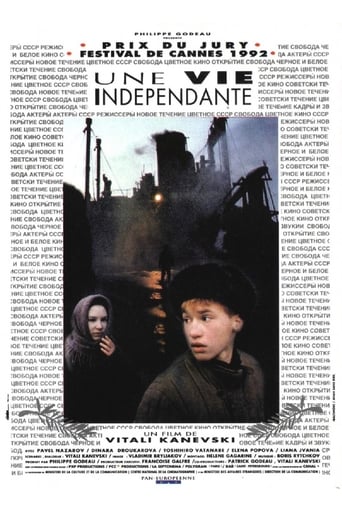
Самостоятельная жизнь (1992)
This is the second installment of a three-part series of autobiographical films about the director's life. The first, which won various awards for its maker, was entitled Zamri Oumi Voskresni and was later retitled Zari, Umri, Vokresni ("Freeze-Die-Come to Life"). At the end of that film, set at the conclusion of World War II, the young Valerka was striving hard to overcome the inertia of just getting by, along with his sometime friend Galiya. In this one, he is adjusting to Galiya's death and is back in school and is living with his mother, a prostitute. After a girl at the school is found to have been gang-raped, the headmaster chooses Valerka to be one of the scapegoats, though he had nothing to do with the deed. The punishment seems mild enough, he was simply expelled from school. However, after quarrelling with his mother about the incident, he takes to the road, and discovers a society so bleak, degraded and hopeless that it is a wonder he remained alive.
- Data lansării
- 1992-05-26
- TMDB
- 4.1 / 10 (14)
- Durată
- 1 h 37 min
- Genuri
- Dramă
- Regizor
- Виталий Каневский
Distribuție
- Елена Попова — мать Валерки
- Павел Назаров — Валерка
- Динара Друкарова — Валя
- Тосихиро Ватанабе — Ямамото
- Лидия Доротенко
- Лиана Жвания — Софья Аркадьевна
- Наталья Ипатова
- Татьяна Иванова
- Галина Кузнецова
- Александр Баширов
- Николай Харитонов
- Иван Прайс
Curiozități
An Independent Life is a 1992 Russian film directed by Vitali Kanevsky. It is the second in a trilogy of autobiographical films. The film was an international co-production between companies in Russia, France and the UK, including StudioCanal and PolyGram Filmed Entertainment. It tied with Dream of Light to win the Jury Prize, the third most prestigious award of the event, at the Cannes Film Festival in 1992.
Citește pe Wikipedia · Text din Wikipedia, CC BY-SA 4.0. Date din Wikidata.
Recomandate
- Bastard Out of Carolina 1996 · ★ 7.1
- Skin 2009 · ★ 6.4
- Pumni de piatră 2016 · ★ 6.6
- Salomé 2013 · ★ 6.1
- Hardball 2001 · ★ 6.5
- Brotherly Love 2015 · ★ 7.0
- Lorelei 2020 · ★ 6.0
- F.I.S.T. 1978 · ★ 6.5
- The Girl in the Book 2015 · ★ 5.8
- Home 2021 · ★ 6.7
- All Day and a Night 2020 · ★ 6.3
- My Neighbor Adolf 2022 · ★ 6.6