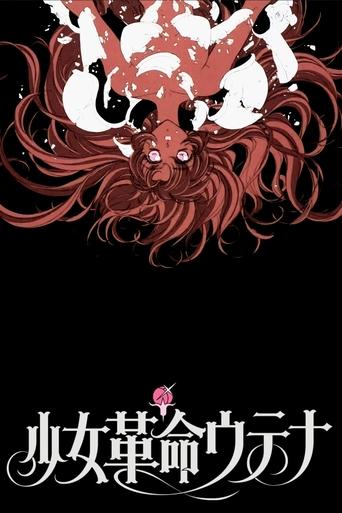
少女革命ウテナ アドゥレセンス黙示録 (1999)
In a loose retelling of the Revolutionary Girl Utena TV series, Utena Tenjou arrives at Ohtori Academy, only to be immediately swept up in a series of duels for the hand of her classmate Anthy Himemiya and the power she supposedly holds. At the same time, Utena reunites with Touga Kiryuu, a friend from her childhood who seems to know the secrets behind the duels. Utena must discover those secrets for herself, before the power that rules Ohtori claims her and her friends, new and old.
- Data lansării
- 1999-08-14
- TMDB
- 7.4 / 10 (92)
- Durată
- 1 h 26 min
- Genuri
- Animaţie, Dramă, Fantasy, Romantic
- Regizor
- 幾原邦彦
Distribuție
- 川上とも子 — Utena Tenjou (voice)
- 渕崎ゆり子 — Anthy Himemiya (voice)
- 及川光博 — Akio Ohtori (voice)
- 三石琴乃 — Juri Arisugawa (voice)
- 久川綾 — Miki Kaoru (voice)
- 子安武人 — Touga Kiryuu (voice)
- 草尾毅 — Kyoichi Saionji (voice)
- 白鳥由里 — Nanami Kiryuu (voice)
- 西原久美子 — Shiori Takatsuki (voice)
- 折笠愛 — Kanae Ohtori (voice)
- 今井由香 — Wakaba Shinohara (voice)
- 本多知恵子 — Kozue Kaoru (voice)
Curiozități
Adolescence of Utena is a 1999 Japanese animated romantic fantasy film. It is a follow-up to the 1997 anime television series Revolutionary Girl Utena, created by the artist collective Be-Papas. The film is directed by Kunihiko Ikuhara, written by Yōji Enokido based on a story by Ikuhara and produced by the animation studio J.C.Staff. An English-language dubbed version of the film produced by Central Park Media was released in 2001 as Revolutionary Girl Utena: The Movie.
Production
Adolescence of Utena was produced by J.C.Staff, in association with the publishing company Shogakukan and the production company GANSIS. The production committee for the film, Shojo Kakumei Utena Seisaku Iinkai (lit. "Revolutionary Girl Utena Production Committee"), was composed of Sega Enterprises, MOVIC, and King Records. Distribution of the film was overseen by Toei Company.
Adolescence of Utena was developed by Be-Papas, the artist collective founded by Ikuhara that produced the Utena anime television series. Ikuhara expressed a desire to create a film that heightened the themes and subject material of the original anime, seeking to "do in the movie what I wasn't able to accomplish in the TV series," and jokingly stated that he wished for Adolescence of Utena to be "more naughty than the TV series."
In contrast to the ensemble cast structure of the anime series, Adolescence of Utena focuses chiefly on the characters Utena and Anthy, with much of the secondary cast relegated to supporting and cameo appearances. The film's version of Utena is depicted as more masculine, appearing initially in short hair and boys' clothing, while Anthy is more strong-willed and overtly sexual; the romantic subtext of Utena and Anthy's relationship is additional…
Adolescence of Utena was released on 35 mm movie film, and was created using a combination of traditional and digital animation. The opening title sequence was created by modifying digital graphics through nonlinear composite editing using a supercomputer, a relatively new process for animation at the time.
Each scene had multiple designs and art directions rendered; for example, Ikuhara has stated that the scene in which Touga first speaks to Utena was initially rendered entirely in monochrome, but colors were ultimately added to make the scene more visually interesting.
Citește pe Wikipedia · Text din Wikipedia, CC BY-SA 4.0. Date din Wikidata.
Recomandate
- Memoirs of a Geisha 2005 · ★ 7.6
- Patema Inverted 2013 · ★ 7.4
- Demon Slayer: Kimetsu no Yaiba -To the Hashira Training- 2024 · ★ 6.5
- Rascal Does Not Dream of a Knapsack Kid 2023 · ★ 7.7
- Over the Sky 2020 · ★ 6.8
- Charlie St. Cloud 2010 · ★ 7.0
- Demon Slayer: Kimetsu no Yaiba -To the Swordsmith Village- 2023 · ★ 7.3
- Maquia: When the Promised Flower Blooms 2018 · ★ 8.1
- Clannad: Filmul 2007 · ★ 7.3
- maboroshi 2023 · ★ 7.2
- Bleach the Movie: Fade to Black 2008 · ★ 7.1
- Hot Gimmick: Girl Meets Boy 2019 · ★ 5.9