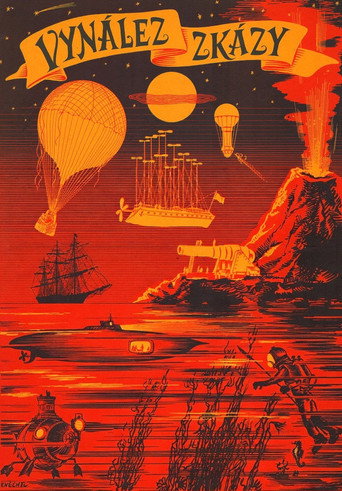
Una invención diabólica (1958)
Vynález zkázy
Un malvado millonario llamado Artigas planea utilizar un artefacto explosivo para doblegar a las naciones libres, operando desde un submarino pirata, donde mantiene como prisionero al inventor del explosivo. En uno de sus raids hunde un buque que llevaba a la bella Jana, la hija del profesor, la cual es rescatada y llevada al cuartel general de Artigas, bajo un enorme volcán. Este filme está basado en la novela 'Face au Drapeau', que Jules Verne escribió en 1896. Combinando collage, animación fotograma a fotograma, falsas perspectivas, decorados, miniaturas y sobreimpresiones, Zeman construyó planos de un barroquismo hipnótico que, en una película como Una invención diabólica, dotaron de vida los aguafuertes elaborados por Benette y Riou para los libros de Julio Verne editados por Pierre-Jules Hetzel.
- Fecha de estreno
- 1958-08-22
- TMDB
- 7.2 / 10 (100)
- Duración
- 1 h 22 min
- Géneros
- Aventura, Ciencia ficción
- Director
- Karel Zeman
Reparto
- Lubor Tokoš — Šimon Hart
- Jana Zatloukalová — Jana
- Arnošt Navrátil — Profesor Roche
- Miloslav Holub — Count Artigas
- František Šlégr — Pirate Captain
- Otto Šimánek — The Man on the Train
- Václav Kyzlink — Ing. Serke
- František Řehák
- Václav Babka
- Alena Kreuzmannová — Jana (voice)
- Felix le Breux — Head Physician (voice)
- František Černý — Capt. Spade
Curiosidades
- Basada en: Ante la bandera
Invention for Destruction is a 1958 Czechoslovak black-and-white science fiction adventure film, directed by Karel Zeman, produced by Zdeněk Novák, and starring Lubor Tokoš, Arnošt Navrátil, and Miloslav Holub. Based on several works by Jules Verne, primarily his 1896 novel Facing the Flag, the film evokes the original illustrations for Verne's works by combining live actors with various forms of animation.
Production
Karel Zeman, a Czech film director and animator, was deeply influenced by the novels of Jules Verne, making four feature films between 1955 and 1970, and drawing extensively on Verne's Voyages Extraordinaires series. The first of these, Journey to the Beginning of Time, was inspired by Journey to the Center of the Earth and featured a scene in which its heroes directly acknowledged their fondness for reading Verne.
The main literary source material for Vynález zkázy was Verne's 1896 novel Facing the Flag. However, rather than a straightforward literal adaptation of the novel, Zeman conceived the film as if the story were being retold by one of its characters, the young engineer Simon Hart.
The film also pays tribute to the style of the pioneering early filmmaker Georges Méliès. Zeman likely saw Méliès's work at the Czech National Film Archive in Prague, where hand-colored prints were available of The Impossible Voyage (1904), The Witch (1906), and The Diabolic Tenant (1909).
The film has long been noted for its unique visual style, which faithfully recreates that of the Victorian line engravings (by Édouard Riou, Léon Benett, and others) featured in the original editions of Verne's novels. According to Karel Zeman's daughter Ludmila Zeman: "As a child, I remember I had all the books with those beautiful engravings. I really can't visualize the story any other way.
The magic of Verne's novels lies in what we would call the world of the romantically fantastic adventure spirit; a world directly associated with the totally specific which the original illustrators knew how to evoke in the mind of the reader … I came to the conclusion that my Verne film must come not only from the spirit of the literary work, but also from the characteristic style of the original illustrations and must maintain at least the impr…
Leer en Wikipedia · Texto de Wikipedia, CC BY-SA 4.0. Datos de Wikidata.
Recomendadas
- La isla del tesoro 1972 · ★ 5.9
- Underwater 2020 · ★ 6.3
- La hora final 1959 · ★ 6.7
- La quinta ola 2016 · ★ 5.9
- La isla del tesoro 1990 · ★ 6.7
- Megalodón 2018 · ★ 6.2
- El planeta del tesoro 2002 · ★ 7.6
- En la playa 2000 · ★ 6.2
- El corsario escarlata 1976 · ★ 6.2
- 20.000 leguas de viaje submarino 1954 · ★ 7.1
- John Carter 2012 · ★ 6.4
- Mentes poderosas 2018 · ★ 7.0