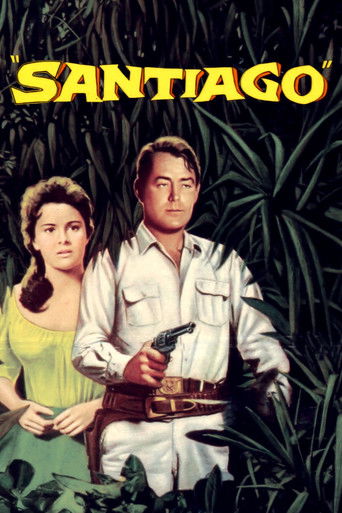
Santiago (1956)
GUN RUNNERS IN THE JUNGLE-OF-NO RETURN!
Two American gun runners at odds with each other and looking to sell guns to the rebels during the Cuban War of Independence navigate a boat to Cuba. Along for the ride is a beautiful Cuban rebel in who both men are interested.
- Date of release
- 1956-07-13
- TMDB
- 5.8 / 10 (9)
- Runtime
- 1h 33m
- Genres
- Adventure, Action
- Director
- Gordon Douglas
Casting
- Alan Ladd — Caleb 'Cash' Adams
- Rossana Podestà — Doña Isabella
- Lloyd Nolan — Clay Pike
- Chill Wills — Captain 'Sidewheel' Jones
- Paul Fix — Trasker
- L.Q. Jones — Digger
- Frank De Kova — Jingo
- George J. Lewis — Pablo
- Royal Dano — Lobo
- Don Blackman — Sam
- Francisco Ruiz — Juanito
- Clegg Hoyt — Dutch
Interesting facts
- Filmed in: California
Santiago, is a 1956 American Warnercolor adventure film directed by Gordon Douglas and starring Alan Ladd, Rossana Podestà and Lloyd Nolan. It is set in 1898 Cuba against the background of the Cuban War of Independence. Martin Rackin wrote the screenplay, based on his unpublished novel, as well as producing the film. Ladd also co-produced the film that was made and distributed by Warner Bros. Pictures.
Production
The project was first announced in July 1955 and was originally known as The Greater Courage. It was based on an unpublished novel by Martin Rackin, who also acted as producer. Although Ladd had his own production company, Jaguar Productions, who released movies through Warner Bros. Pictures, he made this movie for Warners solely as actor.
"The principal difficulty, whether you take a salary from a studio or are in business for yourself, is finding the right story", said Ladd. "Once the story is set, the operation follows a pattern, so you may as well own a piece of the negative – even if you have to beg, borrow or steal to get your hands on it."
Martin Rackin hired John Twist to work on the script. Female lead Rossana Podestà had just made Helen of Troy.
The jungle set cost $125,000. The film's sets were designed by the art director Edward Carrere.
The celebrated Cuban poet, philosopher, and revolutionary patriot José Martí (Ernest Sarracino) also makes an appearance, although the real Martí had been dead and buried for three years by 1898, when this yarn takes place. We never see Antonio Maceo Grajales, the high-ranking liberation fighter supposedly waiting for the munitions in the Cuban village of Santiago, but again, the actual Maceo died in battle near the end of 1896.
Read on Wikipedia · Text from Wikipedia, CC BY-SA 4.0. Data from Wikidata.
Recommended
- Street Fighter: Assassin's Fist The Movie 2014 · ★ 7.2
- Swashbuckler 1976 · ★ 6.2
- Jack Hunter and the Lost Treasure of Ugarit 2010 · ★ 6.5
- Birth of the Dragon 2017 · ★ 5.8
- The Darkest Minds 2018 · ★ 7.0
- The Hunger Games: Mockingjay - Part 2 2015 · ★ 6.9
- Jack Hunter and the Star of Heaven 2009 · ★ 6.4
- Jungle Cruise 2021 · ★ 7.3
- Solo: A Star Wars Story 2018 · ★ 6.6
- Scaramouche 1952 · ★ 7.0
- Alita: Battle Angel 2019 · ★ 7.3
- Star Wars: The Rise of Skywalker 2019 · ★ 6.2