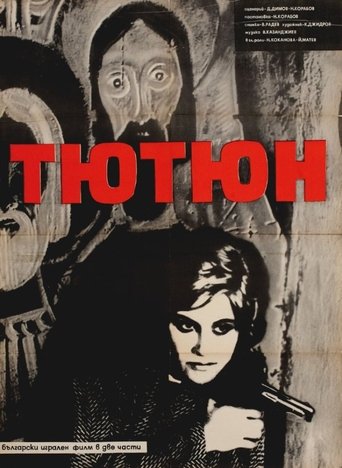
Тютюн (1962)
Boris Morev dreams of money and power, he’ll do everything to reach the top, including leaving his beloved Irina, to marry the daughter of the local tobacco factory owner. With the death of his father-in-law and the illness of his wife, Morev becomes the new owner of "Nicotiana" and rules with an iron fist, resulting in massive labour strikes and murder. He ropes Irina back into his life, first as a mistress and later as his second wife, but his ambitions still come first as he plans on emerging as the biggest tobacco seller once the war is over. Irina’s love for Boris is fading and she finds a lover in one of the Germans Boris is trying to strike a deal with. Set against the backdrop of World War II and communist partisans fighting against the Nazi-allied Bulgarian monarchy, the film is a screen adaptation of the Bulgarian classic novel "Tobacco" released in 1954.
- 개봉일
- 1962-11-05
- TMDB
- 5.6 / 10 (10)
- 상영 시간(분)
- 2시간 30분
- 장르
- 드라마, 전쟁
- 감독
- Nikola Korabov
출연진
- Nevena Kokanova — Irina
- Yordan Matev — Boris Morev
- Miroslava Stoyanova — Lila
- Петър Слабаков — Dinko
- Stefan Pejchev — Kostov
- Georgi Stamatov — Tatko Pier
- Ivan Dimov — Barutchiev
- Ivan Kasabov — Pavel Morev
- Nikola Popov — Shishko
- Luna Davidova — Varvara
- Wolfgang Langhoff — Von Geir
- Magda Kolchakova — Spasuna
흥미로운 사실
Tobacco is a 1962 Bulgarian drama film written and directed by Nikola Korabov, and based on Dimitar Dimov's 1951 novel of the same name. The film deals with the conflicts and contradictions in Bulgarian society during a period stretching from the early thirties to the end of World War II, and stars Nevena Kokanova as Irina, an aspiring medicine student, and Yordan Matev as Boris, an ambitious man from a working class background. It was selected to compete for the Palme d'Or at the 1963 Cannes Film Festival.
Background
In August 1951, the publishing house Narodna Kultura received an internal review of Dimitar Dimov's novel Tobacco from the literary critic Pantelei Zarev. In his review, Zarev made recommendations for corrections in the novel, so that it could be accurate to the principles of socialist realism. However, the novel was printed without the recommended corrections.
In the late autumn of the same year, the book was already on the market. Reader interest in Dimov's work exceeded expectations and the book was sold out within days. In January 1952, Dimov was personally congratulated with a letter from Prime Minister Valko Chervenkov. This did not become public knowledge, but word of mouth spread in literary circles, and in the same month, the Union of Bulgarian Writers nominated Tobacco for the Dimitrov Prize.
Other writers were envious and proposed a discussion of the novel's nomination. At the forum itself, Dimov was criticized for "bending" the party doctrine, and in February of the same year, the Literature Front newspaper published several reviews in a row that criticised the novel.
In 1962, Nikola Korabov began working on a film adaptation of the novel alongside Dimov. Korabov wrote the characters' plot lines, as well as the film's episodes and composition, while Dimov worked on the dialogues. The film's production, however, was also surrounded by controversy.
When word spread around that Nevena Kokanova would play Irina, the Arts Council expressed its disapproval. At that time, she was a trainee actress at the Yambol Theatre, with one or two small roles. Some described Korabov's decision to cast her as "crazy", while Kokanova herself was described as "unprepossessing". Kokanova ultimately portrayed the character which was her breakout role.
위키백과에서 더 읽기 · 텍스트 출처: 위키백과, CC BY-SA 4.0. 데이터 출처: Wikidata.
추천
- 웨이팅 포 안야 2020 · ★ 6.3
- 모뉴먼츠 맨: 세기의 작전 2014 · ★ 6.1
- 비스트 1988 · ★ 7.1
- 민스미트 작전 2022 · ★ 6.5
- 워 빌로우 2021 · ★ 6.6
- 바티칸의 철십자 1983 · ★ 7.1
- 아티의 마지막 여정 2023 · ★ 6.6
- 쉰들러 리스트 1993 · ★ 8.6
- 승리의 탈출 1981 · ★ 6.9
- 배틀그라운드 1949 · ★ 6.7
- 리 밀러: 카메라를 든 여자 2024 · ★ 7.0
- 소비버 탈출 1987 · ★ 7.2