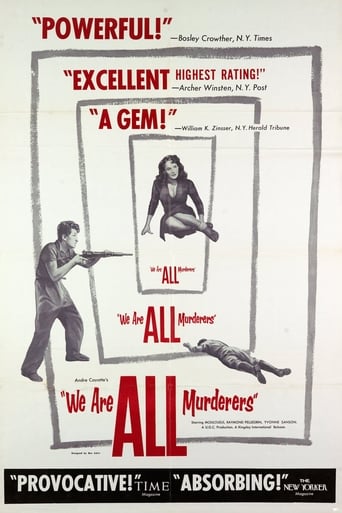
We Are All Murderers (1952)
Nous sommes tous des assassins
Originally titled Nous Sommes Tout des Assassins, We Are All Murderers was directed by Andre Cayette, a former lawyer who detested France's execution system. Charles Spaak's screenplay makes no attempt to launder the four principal characters (Marcel Mouloudji, Raymond Pellegrin, Antoinine Balpetre, Julien Verdeir): never mind the motivations, these are all hardened murderers. Still, the film condemns the sadistic ritual through which these four men are brought to the guillotine. In France, the policy is to never tell the condemned man when the execution will occur--and then to show up without warning and drag the victim kicking and screaming to his doom, without any opportunity to make peace with himself or his Maker. By the end of this harrowing film, the audience feels as dehumanized as the four "protagonists." We Are All Murderers was roundly roasted by the French law enforcement establishment, but it won a special jury prize at the 1952 Cannes Film Festival.
- Date of release
- 1952-05-21
- TMDB
- 6.7 / 10 (25)
- Runtime
- 1h 57m
- Genres
- Crime, Drama
- Director
- André Cayatte
Casting
- Marcel Mouloudji — René Le Guen
- Raymond Pellegrin — Gino Bollini
- Antoine Balpêtré — Dr. Albert Dutoit
- Julien Verdier — Bauchet
- Claude Laydu — Philippe Arnaud
- Georges Poujouly — Michel Le Guen
- Jacqueline Pierreux — Yvonne Le Guen (version française)
- Lucien Nat — L'avocat général
- Louis Arbessier — L'avocat du tribunal pour enfants
- René Blancard — Albert Pichon
- Léonce Corne — Le colonel instructeur
- Henri Crémieux — L'avocat de Bauchet
Interesting facts
We Are All Murderers is a 1952 French-Italian crime drama film written and directed by André Cayatte and starring Marcel Mouloudji, Raymond Pellegrin and Claude Laydu. It was shot at the Boulogne Studios in Paris. The film's sets were designed by the art director Jacques Colombier. It tells the story of René, a young man from the slums, trained by the French Resistance in World War II to kill Germans. He continues to kill long after the war has ended, as it is all he knows. It was entered into the 1952 Cannes Film Festival and won the Special Jury Prize.
Read on Wikipedia · Text from Wikipedia, CC BY-SA 4.0. Data from Wikidata.
Recommended
- Beyond a Reasonable Doubt 1956 · ★ 6.8
- Riot in Cell Block 11 1954 · ★ 7.1
- The Color of Lies 1999 · ★ 5.9
- True Believer 1989 · ★ 6.2
- Rampage 1987 · ★ 5.9
- M 1951 · ★ 6.5
- Judge Fayard Called the Sheriff 1977 · ★ 6.9
- The Sound of Fury 1950 · ★ 6.5
- Symphony for a Massacre 1963 · ★ 6.8
- Winged Creatures 2009 · ★ 5.9
- In His Shadow 2023 · ★ 6.2
- Each Dawn I Die 1939 · ★ 6.9