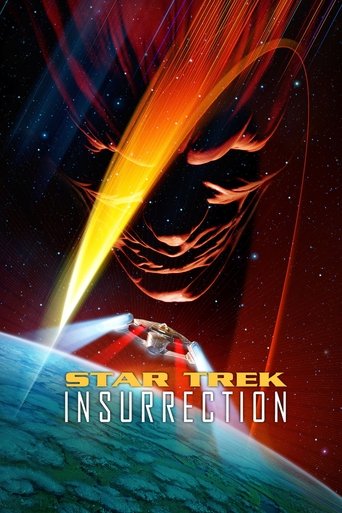
Star Trek: Insurrection (1998)
The battle for paradise has begun.
When an alien race and factions within Starfleet attempt to take over a planet that has "regenerative" properties, it falls upon Captain Picard and the crew of the Enterprise to defend the planet's people as well as the very ideals upon which the Federation itself was founded.
- Date of release
- 1998-12-11
- TMDB
- 6.5 / 10 (1441)
- Runtime
- 1h 43m
- Genres
- Science Fiction, Action, Adventure, Thriller
- Director
- Jonathan Frakes
- Collection
- Star Trek: The Next Generation Collection
Casting
- Patrick Stewart — Captain Jean-Luc Picard
- Brent Spiner — Lt. Commander Data
- Michael Dorn — Lt. Commander Worf
- Jonathan Frakes — Commander William T. Riker
- F. Murray Abraham — Ad'har Ru'afo
- Anthony Zerbe — Vice-Adm. Dougherty
- Gregg Henry — Gallatin
- Donna Murphy — Anij
- Marina Sirtis — Counselor Deanna Troi
- Gates McFadden — Doctor Beverly Crusher
- LeVar Burton — Lt. Commander Geordi La Forge
- Daniel Hugh Kelly — Sojef
Interesting facts
- Box office: $112.6M
- Budget: $58M
- Earned 1.9× its budget
- Filmed in: Paramount Stage 8, Paramount Stage 5, Paramount Stage 9, Paramount Stage 17, Paramount Stage 15, and Paramount Stage 18
- Awards: 1 · Nominations: 3. Including: Best Performance in a Feature Film - Supporting Young Actor
Star Trek: Insurrection is a 1998 American science fiction film directed by Jonathan Frakes. It is the ninth installment in the Star Trek film series, as well as the third to star the cast of Star Trek: The Next Generation, with F. Murray Abraham, Donna Murphy, and Anthony Zerbe appearing in main roles. In the film, the crew of the USS Enterprise-E rebels against Starfleet command after they discover a conspiracy with a species known as the Son'a to steal the peaceful Ba'ku's planet for its rejuvenating properties.
Production
Following the success of Star Trek: First Contact, Paramount Pictures wanted a change of pace and a lighter tone for the follow-up film. Because Star Trek IV: The Voyage Home is light in tone, yet was the most successful of all the Star Trek films at the box office as of then, Paramount reasoned that this success could be repeated with the new film. Michael Piller was asked to write the script, and accepted the position.
Piller initially thought to write a Fountain of Youth-type story, later saying: "Everybody's consumed with images of youth. There's commercials, plastic surgery — our culture seems obsessed with youth." He called the initial treatment "Heart of Lightness". Piller's first draft treatment for the film was titled Star Trek: Stardust, taken from the 1927 song "Stardust" by Hoagy Carmichael after hearing Nat King Cole's version on the radio.
In one draft, Picard kills Data early in the film, and the android is later resurrected to help the Captain in the finale. The first two drafts featured the Romulans as the antagonists, since they had never prominently appeared in a Star Trek film. The second draft was seen by Jonathan Dolgen at the studio; Dolgen was not pleased, and Patrick Stewart thought that it would have been only suitable for a TV episode.
Piller drafted the first version of the script and asked Ira Steven Behr, executive producer of Star Trek: Deep Space Nine, to review it. Behr was critical of the script, describing the Son'a as "paper tigers". Piller said that "I knew he was right.
The studio was pleased with the post-Behr version of the script, which was the first version they saw, having previously only seen pre-script treatments. In a memo to Piller, it was described as "easily the funniest and sexiest Star Trek story to date".
Read on Wikipedia · Text from Wikipedia, CC BY-SA 4.0. Data from Wikidata.
Recommended
- Star Trek Beyond 2016 · ★ 6.8
- Star Trek: Nemesis 2002 · ★ 6.3
- Star Trek Into Darkness 2013 · ★ 7.3
- Star Trek: Generations 1994 · ★ 6.5
- Star Wars: The Rise of Skywalker 2019 · ★ 6.2
- Star Trek: The Motion Picture 1979 · ★ 6.5
- Rebel Moon - Part One: A Child of Fire 2023 · ★ 6.2
- Star Trek II: The Wrath of Khan 1982 · ★ 7.5
- Rogue One: A Star Wars Story 2016 · ★ 7.5
- Star Trek 2009 · ★ 7.4
- Solo: A Star Wars Story 2018 · ★ 6.5
- Ender's Game 2013 · ★ 6.6