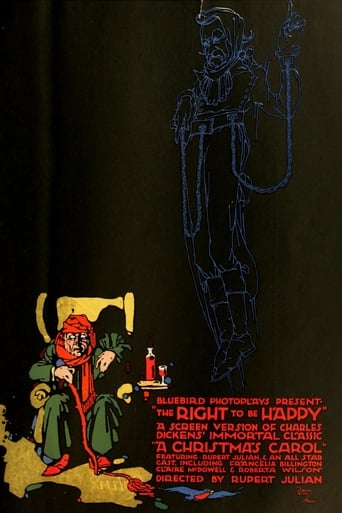
The Right to Be Happy (1916)
Considered to be lost.
- Date of release
- 1916-12-25
- TMDB
- 10.0 / 10 (1)
- Runtime
- 50m
- Genres
- Drama
- Director
- Rupert Julian
Casting
- Rupert Julian — Ebenezer Scrooge
- John Cook — Bob Cratchit
- Claire McDowell — Mrs. Cratchit
- Frankie Lee — Tiny Tim
- Harry Carter — Jacob Marley
- Roberta Wilson — Caroline
- Francelia Billington — Scrooge's Sweetheart
- Lydia Yeamans Titus — Mrs. Fezziwig
- Wadsworth Harris — The Ghost of the Past
- Richard L'Estrange — The Ghost of the Present (as Dick Le Strange)
- Tom Figee — The Ghost of the Future
- Emory Johnson — Fred, Scrooge's Nephew
Interesting facts
The Right to Be Happy is an American silent film from 1916 that draws inspiration from Charles Dickens' 1843 Novella, A Christmas Carol. This film was Universal's first attempt at making a feature film based on Dickens' novella. It was the first and only feature film adaptation of A Christmas Carol by an American or foreign film company during the silent era. The movie was directed by Rupert Julian and supported by a cast of Universal Bluebird players, including Rupert Julian, Claire McDowell, and Harry Carter.
Production
Before the debut of this picture, several short films showcasing A Christmas Carol had already made their way to the silver screen. These films were launched when the technology for feature films was not as advanced. However, these films integrated "Scrooge" or "Christmas Carol" into their titles, rendering them more suitable and tailored explicitly for seasonal viewing.
There are five known screen adaptations preceding the release of A Right to be Happy:
The first known screen adaptation of Dickens's story was the British Short film – "Scrooge, or, Marley's Ghost" directed by Walter R. Booth. The film was 6 minutes and 20 seconds in length and was released in November 1901. The photoplay was produced by Paul's Animatograph Works and became the first worldwide production of A Christmas Carol.
A second adaptation of the story was the American Short film – A Christmas Carol. This film was 15 minutes in length and was released on December 9, 1908. The photoplay was filmed in Chicago and produced by Essanay Studios. The film is presumed lost.
The third screen reproduction was an American Short film – A Christmas Carol directed by J. Searle Dawley. The film had a running time of 13 minutes and was released on December 23, 1910. The photoplay was filmed in New York and produced by Edison Manufacturing Company. It is the second oldest surviving screen adaptation of the famous literary work.
Read on Wikipedia · Text from Wikipedia, CC BY-SA 4.0. Data from Wikidata.
Recommended
- Beggars of Life 1928 · ★ 7.1
- Steven Universe: The Movie 2019 · ★ 8.2
- Brand Upon the Brain! 2007 · ★ 6.6
- Wonderstruck 2017 · ★ 6.1
- Play Dirty 1969 · ★ 6.3
- Northfork 2003 · ★ 6.0
- Flashbacks of a Fool 2008 · ★ 6.2
- Sleep, My Love 1948 · ★ 6.3
- Head Full of Honey 2018 · ★ 6.3
- Heidi 2005 · ★ 7.8
- Won't Back Down 2012 · ★ 6.2
- Salomé 2013 · ★ 6.1