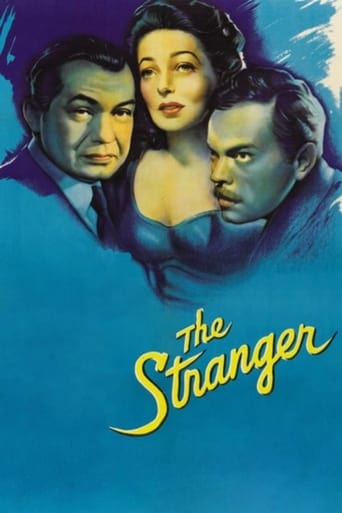
The Stranger (1946)
The most deceitful man a woman ever loved!
An investigator from the War Crimes Commission travels to Connecticut to find an infamous Nazi, who may be hiding out in a small town in the guise of a distinguished professor engaged to the Supreme Court Justice’s daughter.
- Date of release
- 1946-06-02
- TMDB
- 7.2 / 10 (677)
- Runtime
- 1h 35m
- Genres
- Thriller, Crime
- Director
- Orson Welles
Casting
- Edward G. Robinson — Federal Agent Wilson
- Loretta Young — Mary Longstreet
- Orson Welles — Prof. Charles Rankin
- Philip Merivale — Judge Adam Longstreet
- Richard Long — Noah Longstreet
- Konstantin Shayne — Konrad Meinike
- Byron Keith — Dr. Jeffrey Lawrence
- Billy House — Mr. Solomon Potter
- Martha Wentworth — Sara
- David Bond — Student (uncredited)
- John Brown — Passport Photographer (uncredited)
- Neal Dodd — Minister (uncredited)
Interesting facts
- Box office: $3.2M
- Budget: $1M
- Earned 3.1× its budget
- Awards: 0 · Nominations: 1
The Stranger is a 1946 American thriller film noir directed and co-written by Orson Welles, starring himself along with Edward G. Robinson and Loretta Young. Welles's third completed feature film as director and his first film noir, it centers on war crimes investigator Wilson tracking high-ranking Nazi fugitive Franz Kindler to a Connecticut town. It was the first Hollywood film to incorporate actual documentary footage of the Holocaust.
Production
Produced by Sam Spiegel (who then billed himself as S. P. Eagle), The Stranger was the last International Pictures production distributed by RKO Pictures. Filming took place from late September to November 21, 1945, at Samuel Goldwyn Studios and Universal Studios. The film's musical score is by Bronisław Kaper.
Spiegel initially planned to hire John Huston to direct The Stranger. When Huston entered the military, Orson Welles was given the chance to direct the film and prove himself able to make a film on schedule and under budget—something he was so eager to do that he accepted a disadvantageous contract.
Editor Ernest J. Nims was given the power to cut any material he considered extraneous from the script before shooting began. "He was the great supercutter," Welles said, "who believed that nothing should be in a movie that did not advance the story. And since most of the good stuff in my movies doesn't advance the story at all, you can imagine what a nemesis he was to me."
For directing and acting in The Stranger, Welles was to receive $2,000 a week plus $50,000 when the film was completed, and a chance to sign a four-picture deal with International Pictures, making films of his own choosing.
Welles was given some degree of creative control. He worked on the general rewrite of the script, wrote all of the scenes in the drugstore, and wrote scenes at the beginning of the picture that were shot but subsequently cut by Spiegel and executive producer William Goetz. Welles had endeavored to personalize the film and develop a nightmarish tone. There is uncertainty about how much of this material was actually shot and how much was removed.
Read on Wikipedia · Text from Wikipedia, CC BY-SA 4.0. Data from Wikidata.
Recommended
- The Woman in the Window 1944 · ★ 7.4
- The Pelican Brief 1993 · ★ 6.6
- He Ran All the Way 1951 · ★ 7.2
- The Mask of Dimitrios 1944 · ★ 7.1
- The Blue Gardenia 1953 · ★ 6.5
- Black Widow 1987 · ★ 6.2
- Killer's Kiss 1955 · ★ 6.3
- Winged Creatures 2009 · ★ 5.9
- Gotcha! 1985 · ★ 6.0
- Brute Force 1947 · ★ 7.3
- Indemnity 2022 · ★ 6.6
- Suddenly 1954 · ★ 6.4