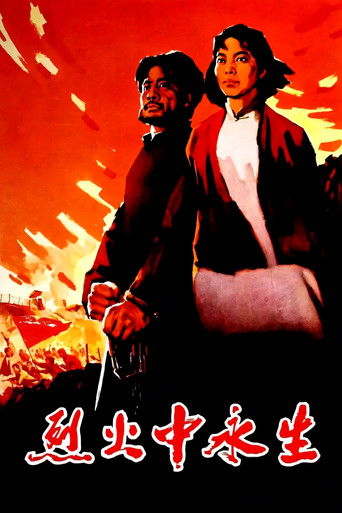
Red Crag (1965)
烈火中永生
A taut wartime thriller, Red Crag: Life in Eternal Flame anticipates the paranoia and violence of the imminent Cultural Revolution while harking back to the aesthetic splendour of the Golden Age Shanghai cinema of the late 1940s. (This opulence is largely due to the work of cinematographer Zhu Jinming, the master visual stylist of Shangrao Concentration Camp and other key "Seventeen Years" films.) The film concerns a hard-boiled woman working in the Chongqing Communist underground during World War II, whose commitment to the guerrilla cause is only intensified after she witnesses her husband's head mounted on the city walls by the Nationalist forces.
- Date of release
- 1965-01-01
- TMDB
- 9.0 / 10 (2)
- Runtime
- 2h 18m
- Genres
- War, Drama
- Director
- Choui Khoua
Casting
- Ran-ran Li
- Yu Lan — Sister Jiang
- Ping Zhang
- Zhao Dan
- Renlin Li — 猩猩
Interesting facts
Eternity in Flames, also known as Red Crag, is a black-and-white 1965 Chinese-language film directed by Shui Hua. Starring Yu Lan and Zhao Dan, it tells the story of a young woman who leads a band of Communist guerillas after the death of her husband. After being betrayed, she is imprisoned with other Chinese Communist Party (CCP) members by the Kuomintang (KMT). Unwilling to betray her cause, she is executed shortly before a mass escape.
Production
Eternity in Flames was adapted from the novel Red Crag (1961), which had been written by Luo Guangbin, Yang Yiyan, and Liu Debin. Survivors of KMT internment camps, they had previously published several recounts of their experiences in newspapers, expanding details in subsequent iterations based on audience feedback.
The actress Yu Lan read excerpts of Red Crag while hospitalized in 1961, later finding a full edition to finish its story. Interested in adapting the novel, she reached out to Shui Hua – who had directed her in A Revolutionary Family (1961) – and proposed a collaboration. The two reached out to the novel's authors, and together they worked on adapting Red Crag to film.
In late 1963, Yu and Shui reached out to the playwright Xia Yan, who had previously worked on Shui's A Revolutionary Family. Xia proposed using the character of Jiang – who in the second draft had only two scenes – as a parallel to Xu Yunfeng, arguing that her status as a wife and mother would draw the emotional investment of audiences. He completed the script in several days, having asked for a week.
Cinematography for the film was handled by Zhu Jinming, who had previously worked on the 1951 film Shangrao Concentration Camp. Filming was done in black-and-white, with on-site shooting done in Chongqing and extras provided by the Chongqing Art Troupe. Several revisions were made, with eighty scenes reportedly reshot to ensure compliance with CCP reviewers' expectations.
The lead role of Jiang was played by Yu Lan, who had previously portrayed the revolutionaries Liu Hulan and Zhao Yiman. At the urging of Xia Yan, she drew on the character's urban-educated background to present her as "a gentle woman with a remarkably strong will and as an ordinary woman of extraordinary deeds." Later in life, she identified the character as a role model, someone she attempted to emulate in her own activities.
Read on Wikipedia · Text from Wikipedia, CC BY-SA 4.0. Data from Wikidata.
Recommended
- The War Below 2021 · ★ 6.6
- The One That Got Away 1957 · ★ 6.8
- Men in War 1957 · ★ 6.6
- Jacknife 1989 · ★ 6.4
- Fort Bliss 2014 · ★ 6.4
- The Last Rifleman 2023 · ★ 6.6
- The Beast of War 1988 · ★ 7.1
- Max 2002 · ★ 6.2
- The Court-Martial of Billy Mitchell 1955 · ★ 6.8
- Waiting for Anya 2020 · ★ 6.3
- One of Our Aircraft Is Missing 1942 · ★ 6.6
- The Scarlet and the Black 1983 · ★ 7.1