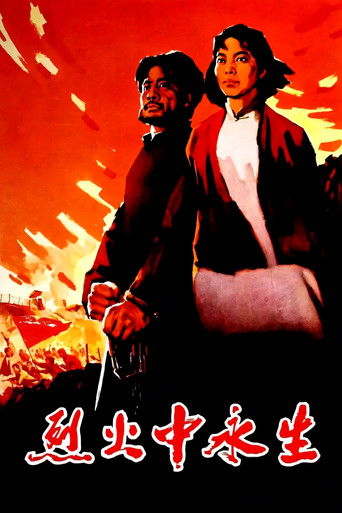
烈火中永生 (1965)
重庆解放前夕的1948年,自知良日不多的国民党开始对共产党人与进步人士进行疯狂的屠杀。江姐(于蓝)在丈夫被杀后,收拾心情来到华蓥山区参加农村武装革命,由于叛徒甫志高的出卖,她和重庆地下党组织领导人许云峰(赵丹)被捕并被囚禁在渣滓洞集中营。国民党先后对许云峰和江姐威逼利诱、严刑拷打,妄图从他们口中得到有关地下党的线索,告失败。而在肉体被折磨时,许云峰和江姐精神上反是越挫越勇,他们带领狱友小萝卜头(方舒)等同国民党展开了一次又一次的斗争。1949年4月,解放军横渡长江,重庆解放在即,许云峰、江姐等人通过在集中营装疯卖傻10余年的华蓥山区党委书记华子良与外面的党组织取得了联系,开始策划越狱行动。
演员阵容
- Ran-ran Li
- 于蓝 — Sister Jiang
- 张平
- 赵丹
- 李壬林 — 猩猩
趣闻
Eternity in Flames, also known as Red Crag, is a black-and-white 1965 Chinese-language film directed by Shui Hua. Starring Yu Lan and Zhao Dan, it tells the story of a young woman who leads a band of Communist guerillas after the death of her husband. After being betrayed, she is imprisoned with other Chinese Communist Party (CCP) members by the Kuomintang (KMT). Unwilling to betray her cause, she is executed shortly before a mass escape.
Production
Eternity in Flames was adapted from the novel Red Crag (1961), which had been written by Luo Guangbin, Yang Yiyan, and Liu Debin. Survivors of KMT internment camps, they had previously published several recounts of their experiences in newspapers, expanding details in subsequent iterations based on audience feedback.
The actress Yu Lan read excerpts of Red Crag while hospitalized in 1961, later finding a full edition to finish its story. Interested in adapting the novel, she reached out to Shui Hua – who had directed her in A Revolutionary Family (1961) – and proposed a collaboration. The two reached out to the novel's authors, and together they worked on adapting Red Crag to film.
In late 1963, Yu and Shui reached out to the playwright Xia Yan, who had previously worked on Shui's A Revolutionary Family. Xia proposed using the character of Jiang – who in the second draft had only two scenes – as a parallel to Xu Yunfeng, arguing that her status as a wife and mother would draw the emotional investment of audiences. He completed the script in several days, having asked for a week.
Cinematography for the film was handled by Zhu Jinming, who had previously worked on the 1951 film Shangrao Concentration Camp. Filming was done in black-and-white, with on-site shooting done in Chongqing and extras provided by the Chongqing Art Troupe. Several revisions were made, with eighty scenes reportedly reshot to ensure compliance with CCP reviewers' expectations.
The lead role of Jiang was played by Yu Lan, who had previously portrayed the revolutionaries Liu Hulan and Zhao Yiman. At the urging of Xia Yan, she drew on the character's urban-educated background to present her as "a gentle woman with a remarkably strong will and as an ordinary woman of extraordinary deeds." Later in life, she identified the character as a role model, someone she attempted to emulate in her own activities.
在维基百科阅读更多 · 文本来自维基百科,CC BY-SA 4.0。数据来自 Wikidata。