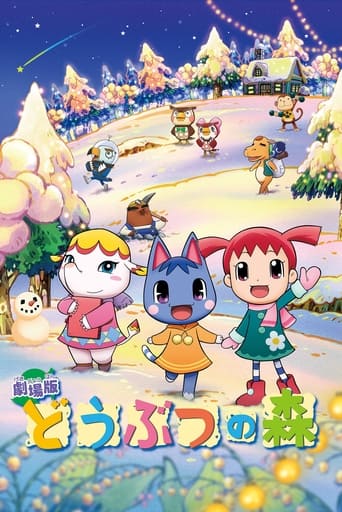
Animal Crossing: Der Film (2006)
どうぶつの森
Ai ist ein selbstständiges Mädchen, welches sich auf den Weg nach "Animal Village" macht. Dort angekommen, schließt sie schnell Freundschaften mit den Bewohnern. Eines Nachts, als sie den Strand entlanggeht, findet sie eine Flaschenpost. Die darin enthaltende Nachricht schickt sie auf eine Mission. Ai pflanzt Kiefern um die Stadt, um so am Abend des Winterfestes das sagenumwobene Wunder herbeizuführen.
- Erscheinungsdatum
- 2006-12-16
- TMDB
- 6.8 / 10 (70)
- Laufzeit
- 1 Std. 27 Min.
- Genres
- Animation, Drama, Familie
- Regie
- 志村錠児
Besetzung
- Yui Horie — Ai (voice)
- Misato Fukuen — Buke (voice)
- Fumiko Orikasa — Sari (voice)
- Yu Kobayashi — Yuu (voice)
- 金子貴俊 — Alberto (voice)
- Masaki Terasoma — Apollo (voice)
- Yurika Hino — Bianka (voice)
- Yasuhiro Takato — Saruo (voice)
- たてかべ和也 — Alan (voice)
- Yuji Ueda — Sakurajima (voice)
- Hisao Egawa — Daruman (voice)
- Naoki Tatsuta — Tanukichi (voice)
Wissenswertes
- Einspielergebnis: 1,7 Mrd. ¥
- Basiert auf: Animal Crossing
Gekijōban Dōbutsu no Mori is a 2006 Japanese animated film directed by Jōji Shimura and based on the Animal Crossing video game series. It was produced by Nintendo, OLM, Inc. and VAP and distributed by Toho. The film opened in theaters in Japan on December 16, 2006, where it went on to earn ¥1.7 billion at the box office.
Production
Gekijōban Dōbutsu no Mori was first announced in a May 2006 issue of the online Japanese magazine Hochi Shimbun, with a theatrical release date set for the following December. The movie entered production due to the success of Animal Crossing: Wild World, released for the Nintendo DS the previous year, which had shipped over 3 million copies in Japan alone.
Those who ordered advance tickets before the film's debut were eligible to receive vouchers which could be redeemed for hard-to-obtain gold tools in Animal Crossing: Wild World. In October 2007, Nintendo of America made a statement that they had "no plans" to bring the film to North America.
Music for Gekijōban Dōbutsu no Mori was contributed by Animal Crossing series composer Kazumi Totaka and arranged by Tomoki Hasegawa, with the film featuring numerous themes from the games. The film's official theme song is "Mori e Ikō" (森へ行こう, Let's Go to the Forest) by Taeko Ohnuki, which plays over the end credits.
Auf Wikipedia weiterlesen · Text aus Wikipedia, CC BY-SA 4.0. Daten aus Wikidata.
Empfohlen
- Colorful 2010 · ★ 7.2
- Summer Ghost 2021 · ★ 7.3
- Child of Kamiari Month 2021 · ★ 6.5
- Pokémon 7: Destiny Deoxys 2004 · ★ 6.7
- Okko und ihre Geisterfreunde 2018 · ★ 7.2
- Pokémon: Mewtu kehrt zurück 2001 · ★ 6.8
- Die Olchis - Willkommen in Schmuddelfing 2021 · ★ 6.7
- Bleach: Fade to Black 2008 · ★ 7.1
- Epic - Verborgenes Königreich 2013 · ★ 6.6
- Pokémon 13: Zoroark - Meister der Illusionen 2010 · ★ 6.8
- Bescheidene Helden: Ponoc Short Films Theatre 2018 · ★ 6.7
- Mirai - Das Mädchen aus der Zukunft 2018 · ★ 7.2