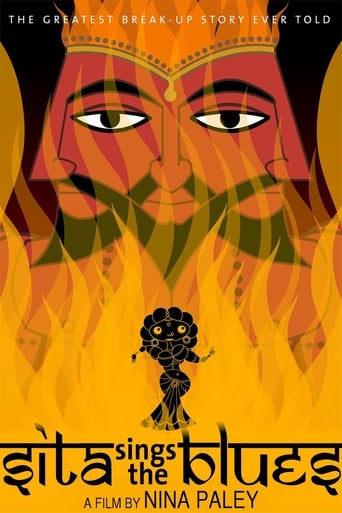
Sita Sings the Blues (2008)
The Greatest Break-Up Story Ever Told.
Utilizing the 1920s jazz vocals of Annette Hanshaw, the epic Indian tale of exiled prince Ramayana and his bride Sita is mirrored by a spurned woman's contemporary personal life, and light-hearted but knowledgeable discussion of historical background by a trio of Indian shadow puppets.
- Date of release
- 2008-02-11
- TMDB
- 7.0 / 10 (88)
- Runtime
- 1h 22m
- Genres
- Animation, Drama, Music, Romance, Fantasy
- Director
- Nina Paley
Casting
- Reena Shah — Sita
- Debargo Sanyal — Rama
- Annette Hanshaw — Sita (singing)
- Aseem Chhabra — Narrator
- Bhavana Nagulapally — Narrator
- Manish Acharya — Narrator
- Sanjiv Jhaveri — Dave / Dasharatha / Ravana / Dhobi / Valmiki
- Pooja Kumar — Surphanaka
- Aladdin Ullah — Mareecha/ Hunuman
- Nina Paley — Nina
- Nitya Vidyasagar — Luv / Kush
- Deepti Gupta — Kaikeyi
Interesting facts
- Awards: 1 · Nominations: 1. Including: Annecy Cristal for a Feature Film
Sita Sings the Blues is a 2008 American independent animated musical romantic comedy-drama film written, directed, produced and animated by American artist Nina Paley. It intersperses events from the Ramayana, light-hearted but knowledgeable discussion of historical background by a trio of Indian shadow puppets, musical interludes voiced with tracks by Annette Hanshaw and scenes from the artist's own life. The ancient mythological and modern biographical plot are parallel tales, sharing numerous themes.
Production
The production was largely completed by Paley, with support from Jake Friedman in the "Battle of Lanka" scene, primarily using 2D computer graphics and Flash Animation.
In addition to the central numbers recorded by Hanshaw, music was provided by Rohan, Rudresh Mahanthappa, Nik Phelps, Todd Michaelsen and Reena Shah of the duo My Pet Dragon, and by Pierre-Jean Duffour, composer and musician for the band Masaladosa. Shah contributed the voice of the Sita character, in addition to choreographing and performing the dance sequences rotoscoped by Paley for the animation.
Paley estimated her total hours of work to 9,360 and calculated she needed 6,240 people to see the 1.5-hour long film to make an "attention profit".
A soundtrack album was released digitally in 2009, consisting of original music composed by Todd Michaelsen and the various jazz standards.
The film uses a number of 1920s Annette Hanshaw recordings. Although Paley initially made sure these recordings were not covered by US copyright law, a number of other copyright issues surfaced, including state laws prior to US federal copyright law on recordings, rights to the compositions and the right to synchronize the recordings with images.
Read on Wikipedia · Text from Wikipedia, CC BY-SA 4.0. Data from Wikidata.
Recommended
- Ramayana: The Legend of Prince Rama 1997 · ★ 8.3
- Strings 2004 · ★ 6.6
- The King of Kings 2025 · ★ 8.3
- Aladdin 1992 · ★ 7.7
- Sofia the First: Once Upon a Princess 2012 · ★ 7.5
- Aladdin 2019 · ★ 7.1
- Mio in the Land of Faraway 1987 · ★ 6.0
- Wildwood 2026 · ★ 8.4
- Soul 2020 · ★ 8.1
- Beauty and the Beast: A 30th Celebration 2022 · ★ 6.8
- Joseph: King of Dreams 2000 · ★ 6.9
- Welcome to Smelliville 2021 · ★ 6.7