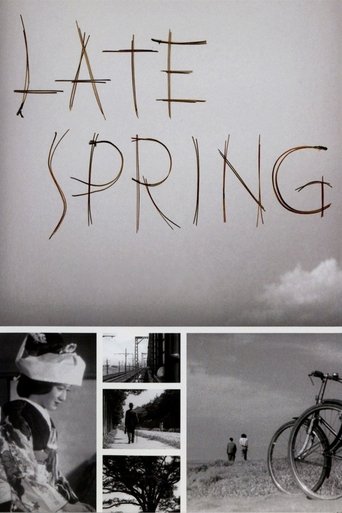
Late Spring (1949)
晩春
Noriko is perfectly happy living at home with her widowed father, Shukichi, and has no plans to marry -- that is, until her aunt Masa convinces Shukichi that unless he marries off his 27-year-old daughter soon, she will likely remain alone for the rest of her life. When Noriko resists Masa's matchmaking, Shukichi is forced to deceive his daughter and sacrifice his own happiness to do what he believes is right.
- Date of release
- 1949-09-13
- TMDB
- 8.0 / 10 (511)
- Runtime
- 1h 48m
- Genres
- Drama
- Director
- Yasujirō Ozu
Casting
- Chishū Ryū — Shukichi Somiya
- Setsuko Hara — Noriko Somiya
- Yumeji Tsukioka — Aya Kitagawa
- Haruko Sugimura — Masa Taguchi
- Hōhi Aoki — Katsuyoshi
- Jun Usami — Shuichi Hattori
- Kuniko Miyake — Akiko Miwa
- Masao Mishima — Jo Onodera
- Yoshiko Tsubouchi — Kiku
- Yōko Katsuragi — Misako
- Toyo Takahashi — Shige
- Jun Tanizaki — Seizo Hayashi
Interesting facts
Late Spring is a 1949 Japanese drama film directed by Yasujirō Ozu and written by Ozu and Kogo Noda, based on the short novel Father and Daughter by the 20th-century novelist and critic Kazuo Hirotsu. The film was written and shot during the Allied Powers' Occupation of Japan and was subject to the Occupation's official censorship requirements. Starring Chishū Ryū, who was featured in almost all of the director's films, and Setsuko Hara, marking her first of six appearances in Ozu's work, it is the first installment of Ozu's so-called "Noriko trilogy", succeeded by Early Summer and Tokyo Story ; in each of which Hara portrays a young woman named Noriko, though the three Norikos are distinct,…
Production
The central event of Late Spring is the marriage of the heroine to a man she has met only once through a single arranged meeting. This immediately presented a problem for the censors of the American Occupation. According to film scholar Kyoko Hirano, these officials "considered feudalistic the Japanese custom of arranged meetings for prospective marriage partners, miai, because the custom seemed to them to downgrade the importance of the individu…
The synopsis explained that the trip to Kyoto by father and daughter, just prior to Noriko's marriage, occurs so she can visit her dead mother's grave. This motivation is absent from the finished film, possibly because the censors would have interpreted such a visit as "ancestor worship," a practice they frowned upon.
Any reference in the script to the devastation caused by the American bombings was removed. In the script, Shukichi remarks to Onodera's wife in Kyoto that her city is a very nice place, unlike Tokyo, with all its ruins. The censors deleted the reference to ruins (as an implied critique of the Allies) and, in the finished film, the word "hokorippoi" ("dusty") was substituted as a description of Tokyo.
The censors at first automatically deleted a reference in the script to the Hollywood star Gary Cooper, but then reinstated it when they realized that the comparison was to Noriko's (unseen) suitor Satake, who is described by the female characters as attractive, and was thus flattering to the American actor.
Sometimes, the censors' demands seemed irrational. A line about Noriko's health having been negatively affected by "her work after being conscripted by the [Japanese] Navy during the war" was changed to "the forced work during the war," as if even the very mention of the Japanese Navy was somehow suspect.
Read on Wikipedia · Text from Wikipedia, CC BY-SA 4.0. Data from Wikidata.
Recommended
- An Autumn Afternoon 1962 · ★ 7.9
- The Flavor of Green Tea Over Rice 1952 · ★ 7.5
- Early Summer 1951 · ★ 7.9
- A Man 2022 · ★ 7.1
- In This Corner of the World 2016 · ★ 7.9
- Tokyo Story 1953 · ★ 8.1
- Maborosi 1995 · ★ 7.5
- Her Love Boils Bathwater 2016 · ★ 7.5
- The Insect Woman 1963 · ★ 7.3
- Before We Vanish 2017 · ★ 6.5
- After the Storm 2016 · ★ 7.2
- Aristocrats 2021 · ★ 7.0