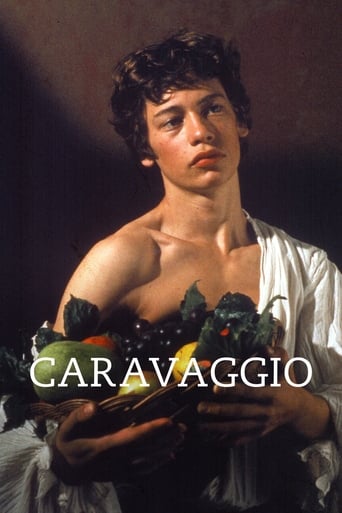
Caravaggio (1986)
His passion came with a price.
A retelling of the life of the celebrated 17th-century Baroque painter Michelangelo Merisi da Caravaggio through his brilliant, nearly blasphemous paintings and his flirtations with the underworld.
- Date of release
- 1986-08-29
- TMDB
- 6.1 / 10 (166)
- Runtime
- 1h 33m
- Genres
- Drama, History, Romance
- Director
- Derek Jarman
Casting
- Nigel Terry — Caravaggio
- Sean Bean — Ranuccio
- Garry Cooper — Davide
- Dexter Fletcher — Young Caravaggio
- Spencer Leigh — Jerusaleme
- Tilda Swinton — Lena
- Nigel Davenport — Giustiniani
- Robbie Coltrane — Scipione Borghese
- Michael Gough — Cardinal Del Monte
- Noam Almaz — Boy Caravaggio
- Dawn Archibald — Pipo
- Jack Birkett — The Pope
Interesting facts
- Awards: 1 · Nominations: 0. Including: Silver Bear
Caravaggio is a 1986 British historical drama film directed by Derek Jarman. The film is a fictionalised retelling of the life of Baroque painter Michelangelo Merisi da Caravaggio.
Production
The idea for a film on the life of the Italian painter Caravaggio was proposed to Jarman by the art dealer Nicholas Ward Jackson. At the time, Jarman knew little about Caravaggio’s life, but was drawn to the painter’s radical reworking of Christian iconography, particularly his use of contemporary figures as sacred subjects, such as portraying a street prostitute as Mary Magdalene.
While developing the project, Jarman drew parallels between Caravaggio and the Italian filmmaker Pier Paolo Pasolini. In his memoir Dancing Ledge, Jarman wrote: “Had Caravaggio been reincarnated in this century it would have been as a film-maker, Pasolini”. During this period, Jarman also wrote an unproduced screenplay, P.P.P.
Jarman wrote the first draft of the screenplay in Rome in 1978. Over the following years he produced approximately sixteen subsequent drafts, during which time he experienced considerable difficulty securing financing for the project. One draft, dated 1982, featured a metafictional framing device in which the filmmaker “Derek Jarman” is persuaded to make a pornographic film based on the life of Caravaggio.
During the extended development period before the film was eventually financed by the British Film Institute, Jarman remained active across multiple artistic disciplines. He painted, directed music videos including Marianne Faithfull’s Broken English (1979), designed sets for Ken Russell’s stage production of Stravinsky’s The Rake’s Progress (1982), published his memoir Dancing Ledge (1984), and returned to making Super 8 films.
Jarman auditioned actors in his flat, filming them on video as part of the casting process. He cast Nigel Terry in the title role, in part because of Terry’s resemblance to the only known painted portrait traditionally identified as Caravaggio. The roles of Ranuccio and Lena were given to Sean Bean and Tilda Swinton respectively, both of whom were relative newcomers.
Read on Wikipedia · Text from Wikipedia, CC BY-SA 4.0. Data from Wikidata.
Recommended
- My Policeman 2022 · ★ 7.5
- Call Me by Your Name 2017 · ★ 8.1
- Total Eclipse 1995 · ★ 6.4
- Those People 2015 · ★ 6.8
- Behind the Candelabra 2013 · ★ 6.6
- On the Edge 2001 · ★ 6.7
- The Edge of Love 2008 · ★ 6.2
- Maurice 1987 · ★ 7.6
- Little Ashes 2008 · ★ 5.8
- Gia 1998 · ★ 7.1
- Tulip Fever 2017 · ★ 6.5
- Original Sin 2001 · ★ 6.2