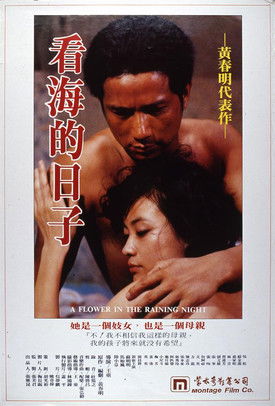
A Flower in the Rainy Night (1983)
看海的日子
A girl, who was sold by her stepfather at the age of 14, has had been a prostitute for 14 years. Her family, despite enjoying a comfortable life with her help, avoids her. She thus decides to have a son of her own and succeeds by sheer determination. She is now hopeful that her son will have a life better than hers.
Casting
Interesting facts
A Flower in the Raining Night is a 1983 Taiwanese film directed by Wang Toon. Adapted from the novel Days of Watching the Sea written by Huang Chun-ming, the film portrays the journey of a prostitute who is determined to become a mother to regain her dignity as a human being. It is one of the few commercially successful films of Taiwan New Cinema in the 1980s, in which its box office reached TWD$23,000,000, HKD$2,536,132.00 and was nominated for Best Narrative Feature at the 20th Golden Horse Awards.
Production
Some scenes of A Flower in the Raining Night were shot at Yilan (Shuang-lian-pi), Jiufen, Hualien and Jinshan. In one of his interviews, Wang Toon mentioned that it is the intimate relationship between people and the ocean that made him choose Hualien and Jinshan as the shooting locations for this film.
The set design of private brothels in the film was based on those at Baodou Village (寶斗里) in Taipei, Huang Chun-ming complained about the brothels in the film being much more spacious than those in reality. Wang Toon defended his portrayal by pointing out the practical need of filmmaking.
Wang Toon graduated from the National Taiwan College of Arts, majoring in fine arts and worked as an art director for many movies before making his first film, If I Were for Real in 1981. As the art director of this film, he tried to use the contrast of light and shadow to represent the different emotions of Bai Mei, especially in the sex scene in which Bai Mei hopes to be impregnated by the fisherman Wu Tiantu.
It is noted that Wang Toon also made use of windows in some key shots to represent the inner emotions of Bai Mei, such as the different stages of Bai Mei’s life from oppression to the new life.
The scene in which Bai Mei breastfed her child was cut because of film censorship at that time in Taiwan, despite Wang Toon’s explanation that the scene is necessary for the film to show Bai Mei’s motherhood.
Read on Wikipedia · Text from Wikipedia, CC BY-SA 4.0. Data from Wikidata.
Recommended
- Lorelei 2020 · ★ 6.0
- Gracie 2007 · ★ 6.2
- Skin 2009 · ★ 6.4
- The Kindness of Strangers 2019 · ★ 6.4
- Trafficked 2017 · ★ 6.6
- Herself 2020 · ★ 6.7
- A Question of Faith 2017 · ★ 7.5
- Charm City Kings 2020 · ★ 7.8
- The Girl in the Book 2015 · ★ 5.8
- Kisses 2008 · ★ 7.1
- Upstream 2024 · ★ 6.8
- The Padre 2018 · ★ 5.9