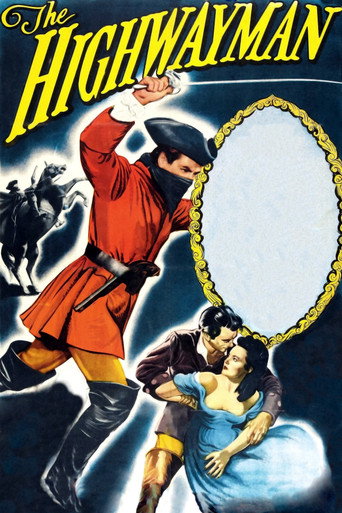
The Highwayman (1951)
During the 1700s, a masked bandit robs the rich and aids the poor, to the chagrin of the authorities and the corrupt nobility, and prompting the king to task a ruthless man from the Colonies to capture the outlaw.
- Fecha de estreno
- 1951-08-11
- TMDB
- 10.0 / 10 (1)
- Duración
- 1 h 22 min
- Géneros
- Aventura
- Director
- Lesley Selander
Reparto
- Philip Friend — Jeremy
- Charles Coburn — Lord Walters
- Wanda Hendrix — Bess Forsythe
- Cecil Kellaway — Lord Herbert
- Victor Jory — Lord Douglas
- Scott Forbes — Sergeant
- Virginia Huston — Lady Ellen Douglas
- Dan O'Herlihy — Robin
- Alan Napier — Barton
- Harry Morgan — Tim
- Albert Sharpe — Forsythe
- Lowell Gilmore — Oglethorpe
Curiosidades
The Highwayman is a 1951 American historical adventure film directed by Lesley Selander and starring Philip Friend, Wanda Hendrix and Cecil Kellaway. The film was shot in Cinecolor and distributed by Allied Artists, the prestige subsidiary of Monogram Pictures. It is based on the poem of the same name by Alfred Noyes.
Production
The film is based on a poem written by Alfred Noyes in 1906. Film rights were owned by James Burkett, who sold them to Monogram Pictures in 1946. Monogram announced that Noyes would collaborate on the script with Jack DeWitt and Duncan Renaldo and that the budget was to be one million dollars.
Noyes determined that his poem would be the basis of the film's final act and that there would be a parallel storyline set in the present day about a woman who works at the tavern and has problems with her love life. Noyes wished to preserve the tragic ending of the poem but also include a happy ending in the present day. He arrived in Hollywood in April 1947 to inspect the script.
In July 1947, the film was officially added to Monogram's production schedule, but filming was delayed. In April 1950, Monogram announced that it would likely produce the film in June with Florence Marley and Rory Calhoun as the stars.
Production of The Highwayman continued to be delayed. In January 1951, Monogram announced that Hal Chester and Bernard Burton would produce and that Charles Coburn would be the film's star, with the script written by Henry Blankfort (a communist who used the pseudonym Jan Jeffries to hide his identity). Filming was set to start on February 19 under the direction of Lesley Selander at the Motion Picture Center.
Noyes wrote in his autobiography that he was surprised by "the fact that in this picture, produced in Hollywood, the poem itself is used and followed with the most artistic care." Portions of the film were shot at the Corriganville Movie Ranch.
Leer en Wikipedia · Texto de Wikipedia, CC BY-SA 4.0. Datos de Wikidata.
Recomendadas
- Destino de caballero 2001 · ★ 6.9
- Las cuatro plumas 2002 · ★ 6.6
- Mercenarios sin gloria 1969 · ★ 6.3
- Matar a un rey 2003 · ★ 5.8
- Rob Roy, la pasión de un rebelde 1995 · ★ 6.7
- Valhalla Rising 2010 · ★ 6.1
- Oro negro 2011 · ★ 6.5
- Los cañones de Navarone 1961 · ★ 7.3
- Los reyes del sol 1963 · ★ 6.2
- Último tren a Katanga 1968 · ★ 6.6
- Los inconquistables 1947 · ★ 6.5
- Pisando fuerte 2004 · ★ 6.4