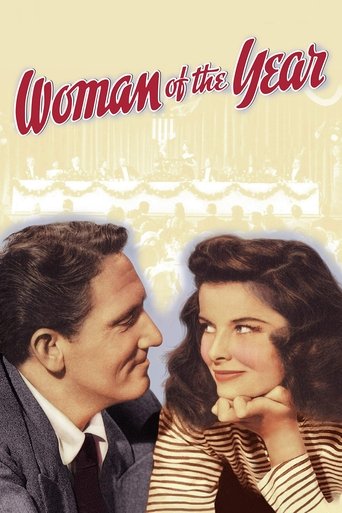
Woman of the Year (1942)
The picture of the year!
Rival reporters Sam Craig and Tess Harding fall in love and get married, only to find their relationship strained when Sam comes to resent Tess' hectic lifestyle.
- Date of release
- 1942-02-05
- TMDB
- 7.0 / 10 (173)
- Runtime
- 1h 54m
- Genres
- Comedy, Romance, Drama
- Director
- George Stevens
Casting
- Spencer Tracy — Sam Craig
- Katharine Hepburn — Tess Harding
- Fay Bainter — Ellen Whitcomb
- Reginald Owen — Clayton
- Minor Watson — William J. Harding
- William Bendix — Pinkie Peters
- Gladys Blake — Flo Peters
- Dan Tobin — Gerald Howe
- Roscoe Karns — Phil Whittaker
- William Tannen — Ellis
- Ludwig Stössel — Dr. Lubbeck
- Sara Haden — Matron
Interesting facts
- Budget: $1M
- Awards: 1 · Nominations: 2. Including: Academy Award for Best Writing, Original Screenplay
Woman of the Year is a 1942 American romantic comedy drama film directed by George Stevens and starring Spencer Tracy and Katharine Hepburn. The film was written by Ring Lardner Jr. and Michael Kanin, and produced by Joseph L. Mankiewicz. The film's plot is about the relationship between Tess Harding—an international affairs correspondent, chosen "Woman of the Year"—and Sam Craig—a sportswriter—who meet, marry, and encounter problems as a result of her unflinching commitment to her work. In 1999, Woman of the Year was deemed "culturally, historically, or aesthetically significant" by the United States Library of Congress and selected for preservation in the National Film Registry.
Production
The outline for the film was developed by Garson Kanin, a close friend of Hepburn's. The character of Tess Harding was based on Dorothy Thompson, an American journalist and radio broadcaster who was highly influential. Hepburn then passed the outline to Joseph L. Mankiewicz at MGM, and said the price was $250,000 – half for her, half for the script. He liked it and agreed to produce the movie.
Woman of the Year was the first of nine films Hepburn and Tracy made together. They met for the first time on the shoot. In the 1993 documentary Katharine Hepburn: All About Me, Hepburn herself says she was wearing high heels at the first meeting with Tracy and producer Joseph L. Mankiewicz, and said "I'm afraid I'm a bit tall for you, Mr. Tracy".
The film was originally shot with a different ending, but it proved unpopular at test screenings. The decision was made to change it, and the final fifteen minutes of the film were re-written and shot. In the original ending, Sam went missing after returning the child to the orphanage, while he was supposed to write an article about an upcoming boxing match. Tess decides to take over for him and visits the gym to learn about the fight.
Ring Lardner Jr. describes in Archive of America Television oral history interviews (2000) that changes made to the ending of the film were against the wishes of Katharine Hepburn, and were implemented while both screenwriters were on vacation in New York. The changes were instigated by Louis B. Mayer, producer Joseph L. Mankiewicz and director George Stevens, with the actual new ending being written by John Lee Mahin (who was uncredited).
Read on Wikipedia · Text from Wikipedia, CC BY-SA 4.0. Data from Wikidata.
Recommended
- Heartburn 1986 · ★ 6.0
- The Invite 2026 · ★ 7.2
- My Sassy Girl 2008 · ★ 6.8
- One Night Only 2026 · ★ 6.5
- His Girl Friday 1940 · ★ 7.4
- The Drama 2026 · ★ 6.9
- Manhattan 1979 · ★ 7.7
- Players 2024 · ★ 6.0
- Down with Love 2003 · ★ 6.1
- The Best You Can 2025 · ★ 7.0
- Someone Great 2019 · ★ 6.4
- Broadcast News 1987 · ★ 6.8