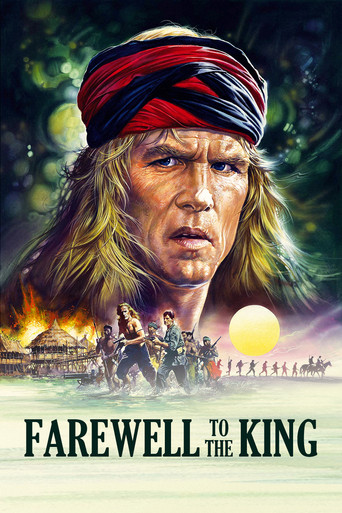
Farewell to the King (1989)
In the midst of war, one man vanished into the jungle, and emerged as king.
An American soldier who escapes the execution of his comrades by Japanese soldiers in Borneo during WWII becomes the leader of a personal empire among the headhunters in this war story told in the style of Joseph Conrad and Rudyard Kipling. The American is reluctant to rejoin the fight against the Japanese on the urging of a British commando team but conducts a war of vengeance when the Japanese attack his adopted people.
- Date of release
- 1989-03-03
- TMDB
- 6.0 / 10 (81)
- Runtime
- 1h 57m
- Genres
- War, Adventure
- Director
- John Milius
Casting
- Nick Nolte — Learoyd
- Nigel Havers — Capt. Fairbourne
- Marilyn Tokuda — Yoo
- Frank McRae — Sgt. Tenga
- Gerry Lopez — Gwai
- James Fox — Col. Ferguson
- Marius Weyers — Sgt. Conklin
- John Bennett Perry — Gen. MacArthur
- Aki Aleong — Col. Mitamura
- Elan Oberon — Vivienne
- Wayne Pygram — Bren Armstrong
- Choy Chang Wing — Lian
Interesting facts
- Based on: L'Adieu au Roi
Farewell to the King is a 1989 American action adventure drama film written and directed by John Milius. It stars Nick Nolte, Nigel Havers, Frank McRae, and Gerry Lopez and is loosely based on the 1969 novel Farewell to the King by Pierre Schoendoerffer. Longtime Milius collaborator Basil Poledouris composed the musical score.
Production
Pierre Schoendoerffer originally wrote the story as a film script. He then turned it into a novel, which was published in 1969 and became a best seller in France, selling over 300,000 copies in hardback. He made the lead character Irish because "the Irish are mad and I like mad people."
"I was wanting to make a great symphonic book on life and death: on how a man can struggle until the very end, without hope and without reason, just to be alive, even though half dead., even though suffering terribly, because life is so powerful. But on the other hand I was wanting to show that if suddenly a man discovers that he is not fulfilling his dream, then he does not want to live anymore."
The story had some basis in historical fact. Tom Harrisson's stay with the Dayaks during the Second World War was the inspiration for much of what happened in the novel along with the allied drop behind Japanese lines known as Operation Semut.
The film was originally going to be made in 1972, directed by Schoendoerffer and produced by Robert Dorfman, starring Donald Sutherland. However, it was not made. John Milius was interested in the themes of the book. In 1976, he said:
My greatest fantasy is to go off to some foreign land and become a legend of some sort, like The Man Who Would Be King or Heart of Darkness. One of my favorite movies is Return to Paradise, Mark Robson's film with Gary Cooper. That film is my ultimate fantasy. Judge Roy Bean is very similar to it: the idea of a man going off to a primitive culture and becoming a legend and a god. As they say in Citizen Kane, "Lording it over the monkeys."
Read on Wikipedia · Text from Wikipedia, CC BY-SA 4.0. Data from Wikidata.
Recommended
- Too Late the Hero 1970 · ★ 6.4
- Letters from Iwo Jima 2006 · ★ 7.5
- Flags of Our Fathers 2006 · ★ 6.9
- The Thin Red Line 1998 · ★ 7.4
- Operation Blood Hunt 2024 · ★ 6.4
- King Rat 1965 · ★ 7.1
- Force 10 from Navarone 1978 · ★ 6.3
- The Dogs of War 1980 · ★ 5.8
- Robinson Crusoe 1997 · ★ 6.0
- Back to Bataan 1945 · ★ 6.1
- Missing in Action 1984 · ★ 5.9
- The Most Dangerous Game 1932 · ★ 6.9