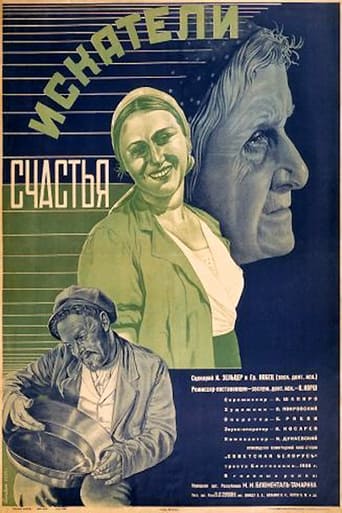
Seekers of Happiness (1936)
Искатели счастья
During the 1920s, many impoverished Jews searching for a better life made their way to Birobidzhan, the Soviet Jewish Autonomous Region on the Chinese border. This melodrama tells the story of a Jewish family's immigration to Birobidzhan and their experiences as settlers on a collective farm in the area.
- Date of release
- 1936-09-25
- TMDB
- 6.8 / 10 (4)
- Runtime
- 1h 24m
- Genres
- Drama
- Director
- Vladimir Korsh
Casting
- Mariya Blyumental-Tamarina — Dvoira
- Venyamin Zuskin — Pinya Kopman
- Lyubov Shmidt — Rosa
- Lyudmila Tayts — Basya Kopman
- Aleksandr Karev — Natan
- Sergei Yarov — Kornei
- Boris Zhukovsky — Kornei's Father
- Iona Biy-Brodskiy — Shlyoma Petrovich
- Nikolai Valyano — Lyova (uncredited)
- Aleksandr Melnikov — Solomon (uncredited)
- Emil Gal — Zionist (uncredited)
- Georgiy Gorbunov — (uncredited)
Interesting facts
Seekers of Happiness is a 1936 Soviet film about Jewish settlers relocating to the Jewish Autonomous Oblast in the far east of the Soviet Union. It is also known by its alternative name, A Greater Promise.
Background
The JAO experiment arose from different tendencies and conflicts in the broader discourse on the so-called “Jewish question” in Russia of the early 20th century and shifts in the national policies of the post-revolutionary society.
The phenomena of the JAO stands both in the context of the Zionist idea of Jewish Statehood and the history of the Jews in the Soviet Union, hence under consideration of the changing governmental policies on the matter and on the question of national policies in general. Before the October Revolution there were three main positions on the Jewish side on the matter of the “Jewish question”. Two within Zionism, and one outside of it.
In the beginning of the 20th century, before the October Revolution, a tense conflict between the Bund and the Iskra-group around Lenin broke out. The Bund called for the federal restructuring of the Russian Social Democratic Labor Party (RSDRP), and the recognition of Jews as a nation. Both claims where heavily rejected by the Iskra-group as being separatist and backward.
However, the post-revolutionary situation required a conceptual shift. At the end of the 19th century 74% of the Jewish population, due to restrictions in the tsarist times, “made livings from petty commerce, retail sales, small-scale handicraft production, and unskilled labor”, while only 3.5% worked in agriculture.
The implementation of the NEP (New Economic Policy) in 1921, which brought back a low form of capitalist production, mitigated the situation partly. But many Jews fell under the category of lišency. Lišency means: “those who are deprived of rights” and was used as a political instrument to fight bourgeois elements. It was generally applied to all who were considered to have worked in sections that fell under the category of “unproductive labor”.
Read on Wikipedia · Text from Wikipedia, CC BY-SA 4.0. Data from Wikidata.
Recommended
- Holy Lands 2019 · ★ 6.1
- Bastard Out of Carolina 1996 · ★ 7.1
- The Safety of Objects 2002 · ★ 6.5
- O.G. 2018 · ★ 6.0
- Dear Comrades! 2020 · ★ 7.1
- Eleanor the Great 2025 · ★ 6.8
- Xiu Xiu: The Sent-Down Girl 1998 · ★ 7.2
- The Visit 1964 · ★ 7.2
- Closeness 2017 · ★ 6.7
- Salomé 2013 · ★ 6.1
- TalhotBlond 2012 · ★ 6.3
- Hurry Sundown 1967 · ★ 6.4