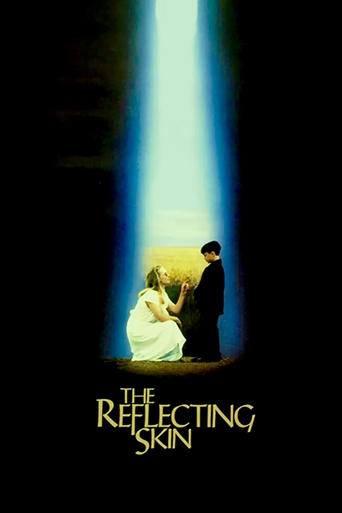
The Reflecting Skin (1990)
Sometimes terrible things happen quite naturally.
In 1950s rural Idaho, a young boy watches helplessly as his friends and brother fall under the spell of a mysterious widow living up the road and becomes convinced that she is a vampire.
- Date of release
- 1990-08-28
- TMDB
- 6.7 / 10 (236)
- Runtime
- 1h 35m
- Genres
- Drama, Thriller, Horror
- Director
- Philip Ridley
Casting
- Viggo Mortensen — Cameron Dove
- Lindsay Duncan — Dolphin Blue
- Jeremy Cooper — Seth Dove
- Sheila Moore — Ruth Dove
- Duncan Fraser — Luke Dove
- David Longworth — Joshua
- Robert Koons — Sheriff Ticker
- David Bloom — Deputy
- Evan Hall — Kim
- Codie Lucas Wilbee — Eben
- Sherry Bie — Cassie
- Jason Wolfe — Cadillac Driver
Interesting facts
- Budget: $1.5M
- Awards: 2 · Nominations: 0. Including: Sitges Film Festival Best Actor award; Sitges Film Festival Best cinematography
The Reflecting Skin is a 1990 coming-of-age psychological horror film written and directed by Philip Ridley and starring Jeremy Cooper, Viggo Mortensen, and Lindsay Duncan. Set in 1950s rural Idaho, the film follows an impressionable young boy who comes to believe that a neighboring widow is a vampire responsible for a number of disappearances in the community. Described by its director as a "mythical interpretation" of childhood, the film weaves elements of vampirism, surrealism, black comedy, symbolism, and religious zealotry throughout its narrative.
Production
Philip Ridley was inspired to write the screenplay for The Reflecting Skin after completing a sequence of artworks titled American Gothic whilst studying at St Martin's School of Art. "I read a lot of American literature when I was a child growing up and saw a lot of American films so what I did, particularly in The Reflecting Skin, is that I created a fabulous child-eyed view of what I imagined America to be like – it's a kind of mythical once u…
Upon directing two short films (Visiting Mr. Beak and The Universe of Dermot Finn) and completing the screenplay for The Krays (directed by Peter Medak), Ridley received $1.5 million of funding from the BBC, British Screen and Zenith Productions to shoot The Reflecting Skin in Crossfield, Alberta, Canada.
In collaboration with director of photography Dick Pope, Ridley channelled his artistic influences (including Andrew Wyeth and Edward Hopper) to create a hyper-realised vision of a "mythical, hallucinogenic summer in the life of a child." This extended to Ridley personally spray-painting the wheatfields a brighter shade of yellow, and shooting exterior scenes at 'magic hour', "when the sun was at its most intense and golden." The film also featur…
Read on Wikipedia · Text from Wikipedia, CC BY-SA 4.0. Data from Wikidata.
Recommended
- Spell 2020 · ★ 6.4
- Becky 2020 · ★ 6.3
- Bone Tomahawk 2015 · ★ 6.9
- Brightburn 2019 · ★ 6.2
- Intrusion 2021 · ★ 5.9
- Echoes of War 2015 · ★ 6.0
- End of the Road 2022 · ★ 5.9
- The Village 2004 · ★ 6.5
- Cape Fear 1962 · ★ 7.4
- The Boy 2015 · ★ 5.8
- Antlers 2021 · ★ 6.2
- A Good Woman Is Hard to Find 2019 · ★ 6.1