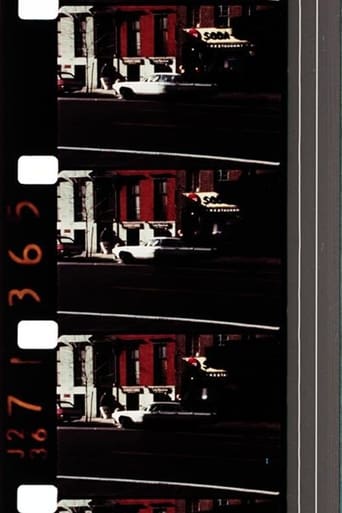
Still (1971)
"This collapse of separate times into one image creates another push/pull with the experience of depth. The superimpositions seem to lie on top of the image, yet they move into depth, creating what Gehr describes as a 'teasing play with planes.' But the play with space and position here involves more than tension between layers. The variations on light and shadow on the two levels cause the double-exposures to pop in and out of depth. A shadow on the first level can give the superimposition a sudden burst of solidity. Gehr calls our attention to the multiplicity of depth cues that operate in a film in addition to perspective recession. The cue of overlap creates much of the amusement of the film, as the vehicles on one level plow through the phantoms on the other. Gehr was particularly fascinated by the way depth cues provided by color (with warm colors coming forward) interact with the logic of space..." – Tom Gunning
- Date of release
- 1971-01-01
- TMDB
- 4.0 / 10 (3)
- Runtime
- 55m
- Director
- Ernie Gehr
Interesting facts
Still is a 1971 American experimental film by Ernie Gehr. It consists of several long takes of a city street, presented as double exposures taken from the same location at different times of day.
Production
Gehr worked at the Film-Makers' Cooperative, in a ground-floor office at 175 Lexington Avenue. His desk was near a window, through which he was able to observe the people and cars moving along the street. At one point, Gehr made small rectangles out of black paper, which he taped to the window and peered through as if they were frames. The first four sections were shot on entire 100-foot rolls of film, using a Bolex camera.
Gehr decided that he needed longer takes but lacked equipment for recording longer rolls or synchronous sound. He managed to borrow it from faculty at Binghamton University. Gehr's shooting schedule was limited by his ability to arrange for someone to transport equipment from Vestal into Manhattan.
Read on Wikipedia · Text from Wikipedia, CC BY-SA 4.0. Data from Wikidata.
Recommended
- Mad God 2021 · ★ 6.8
- Planes 2013 · ★ 5.9
- Shadow in the Cloud 2021 · ★ 5.8
- Hot Shots! 1991 · ★ 6.6
- Migration 2023 · ★ 7.3
- The House 2022 · ★ 7.0
- Black Box 2026 · ★ 5.9
- Death Race 2000 1975 · ★ 6.2
- Fireheart 2022 · ★ 7.2
- Dick Johnson Is Dead 2020 · ★ 7.1
- Hot Wheels AcceleRacers: Ignition 2005 · ★ 8.4
- Planes: Fire & Rescue 2014 · ★ 6.2