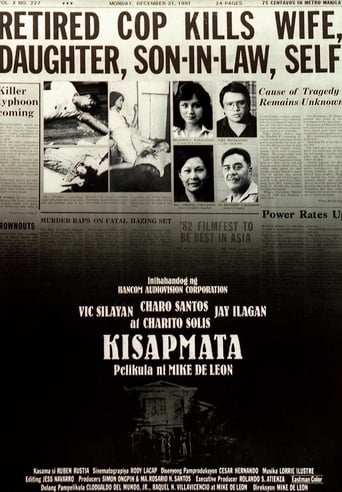
Kisapmata (1981)
Dadong Carandang, un agente de policía retirado, es el padre dominante de Mila, extremadamente celoso de sus pretendientes, nunca les deja entrar en casa. Un día, Mila se enamora de Noel Manalansan y deciden conseguir el permiso de Dadong para casarse. Con el tiempo, los celos y el rencor, irán agravando la relación de Dadong con su hija.
- Fecha de estreno
- 1981-12-01
- TMDB
- 8.1 / 10 (32)
- Duración
- 1 h 39 min
- Géneros
- Crimen, Drama, Suspense
- Director
- Mike de Leon
Reparto
- Charo Santos-Concio — Mila Carandang
- Jay Ilagan — Noel Manalansan
- Vic Silayan — Tatang / Sgt. Diosdado Carandang
- Charito Solis — Nanang / Adelina Carandang
- Ruben Rustia — Peping Manalansan
- Aida Carmona — Onyang
- Juan Rodrigo — Ernie
- Dindo Angeles — Mario
- Cora Alforja — Cynthia
- Mely Mallari — Diomy
- Edwin O'Hara — Police 1
- Mandy Bustamante — Police 2
Curiosidades
Kisapmata is a 1981 Filipino psychological horror drama film directed by Mike de Leon from a screenplay he co-wrote with Clodualdo del Mundo Jr. and Raquel Villavicencio. It stars Vic Silayan, Charo Santos, Jay Ilagan, and Charito Solis. The plot was inspired by the crime reportage "The House on Zapote Street" written by Nick Joaquin. The piece chronicles the events leading to the highly publicized familicide committed by Pablo Cabading, a retired policeman.
Production
The film was inspired by The House on Zapote Street: The Curious Drama Behind the Massacre Last Week in Makati, written by Nick Joaquin under the pen name Quijano de Manila. The report was first published in the Philippine Free Press on January 28, 1961, and was later included in Joaquin's collection Reportage on Crime: Thirteen Horror Happenings that Hit the Headlines, published in 1977.
On January 18, 1961, Cabading shot his daughter, Lydia Cabading-Quitangon, and his son-in-law, Leonardo, both of whom were medical doctors. After killing the newly-weds, Cabading shot himself. His wife, Asuncion, survived and would later attempt to stop the release of the film.
Joaquin's reportage is silent about any rape that may have been committed by the father but academic Joyce Arriola states that "the text suggests that possibility." De Leon was also influenced by the 1978 novel Blood Secrets by Craig Jones, which further developed the theme of incest.
The original version of the film omits Joaquin's name. According to de Leon, this was because the film's producers were seeking to avoid explicit reference to the real case. In the restored copy, the journalist is credited.
After the release of Kung Mangarap Ka't Magising, de Leon was interested in adapting a story based on real events, writing in his memoir, "Countless true stories are waiting to be filmed. So why would I settle for fiction?" According to the director, in the 1970s, he was approached by the brother of one of the convicted perpetrators of the rape of Maggie de la Riva to make a movie about the crime.
Leer en Wikipedia · Texto de Wikipedia, CC BY-SA 4.0. Datos de Wikidata.
Recomendadas
- Chantaje 2007 · ★ 6.5
- Susurran tu nombre 2026 · ★ 6.8
- Ken Park 2003 · ★ 6.0
- El asesinato de la familia Borden (Lizzie) 2018 · ★ 6.2
- La chica en el sótano 2021 · ★ 7.6
- Vidas en pedazos 2019 · ★ 6.7
- 180 2026 · ★ 5.9
- Back Roads 2019 · ★ 5.9
- El cabo del miedo 1991 · ★ 7.3
- Hombres frente a frente 1986 · ★ 6.8
- Rey Marfil 2025 · ★ 7.0
- Metro Manila 2013 · ★ 7.3