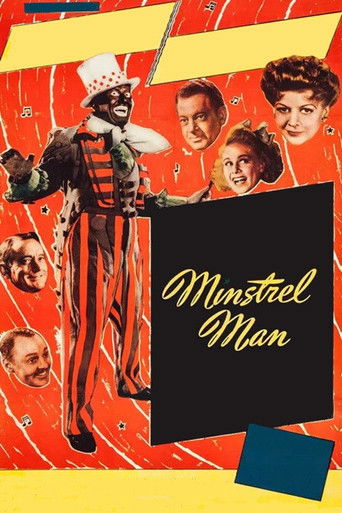
Minstrel Man (1944)
Unusually elaborate for a PRC film, Minstrel Man is a lively musical drama built around the talents of veteran vaudevillian Benny Fields. The star is cast as Dixie Boy Johnson, who rises from the ranks of minstrel shows to become a top Broadway attraction. On the opening night of his greatest stage triumph, Dixie Boy's wife dies in childbirth. Profoundly shaken, he walks out of the show, leaving the baby to be raised by his showbiz pals Mae and Lasses White (Gladys George, Roscoe Karns). The kid grows up to be an attractive young woman named Caroline (Judy Clark), who follows in her dad's footsteps by billing herself as-that's right-Dixie Girl Johnson. This leads to a tearful reunion between Caroline and the father she'd long assumed to be dead. If Minstrel Man seems at times to be a dress rehearsal for Columbia's The Jolson Story (1946), it shouldn't surprising: the PRC film was directed by Joseph H. Lewis, who went on to helm Jolson Story's musical highlights.
- Date of release
- 1944-01-02
- TMDB
- 5.5 / 10 (6)
- Runtime
- 1h 10m
- Genres
- Music
- Director
- Joseph H. Lewis, Edgar G. Ulmer
Casting
- Benny Fields — Dixie Boy Johnson
- Gladys George — Mae White
- Alan Dinehart — Lew Dunn
- Roscoe Karns — Lasses White
- Jerome Cowan — Bill Evans
- Judy Clark — Caroline Jr.-16 years old
- Molly Lamont — Caroline Johnson
- John Raitt — Singer
Interesting facts
- Awards: 0 · Nominations: 1
Minstrel Man is a 1944 American musical drama film directed by Joseph H. Lewis and produced by Producers Releasing Corporation (PRC). It was a vehicle for Broadway and vaudeville headliner Benny Fields.
Production
Production began in late 1943, but was shut down for four weeks and retooled when various cast and crew members became unavailable. Director Joseph H. Lewis was drafted during production; he was briefly replaced by Edgar G. Ulmer and then Wallace W. Fox. Lewis was released from the army in March 1944 and completed the film.
Female lead Binnie Barnes had a prior commitment to Metro-Goldwyn-Mayer and had to drop out; she was replaced by Gladys George. The juvenile role was intended for PRC contractee Gerra Young, who was sidelined by illness; she was replaced by Judy Clark.
Producer Leon Fromkess originally budgeted Minstrel Man at $80,000, slightly above average for the very-low-budget PRC studio. When Fromkess saw how well the project was progressing, he allocated more money. Composer Harry Revel co-wrote the original songs with Paul Francis Webster; Revel was equally impressed with the project and invested his own money, earning an "associate producer" credit.
Read on Wikipedia · Text from Wikipedia, CC BY-SA 4.0. Data from Wikidata.
Recommended
- Apple Music Live: Lady Gaga MAYHEM Requiem 2026 · ★ 8.3
- A Mighty Wind 2003 · ★ 6.8
- Ghosts 1997 · ★ 8.1
- I Am Easy to Find 2019 · ★ 7.1
- Teen Spirit 2019 · ★ 6.0
- Battle of the Year 2013 · ★ 6.8
- Too Late Blues 1961 · ★ 6.4
- A Very Jonas Christmas Movie 2025 · ★ 6.2
- Michael Jackson Video Greatest Hits: HIStory 1995 · ★ 8.3
- Star! 1968 · ★ 6.9
- Coyote Ugly 2000 · ★ 6.3
- Beauty and the Beast: A 30th Celebration 2022 · ★ 6.8