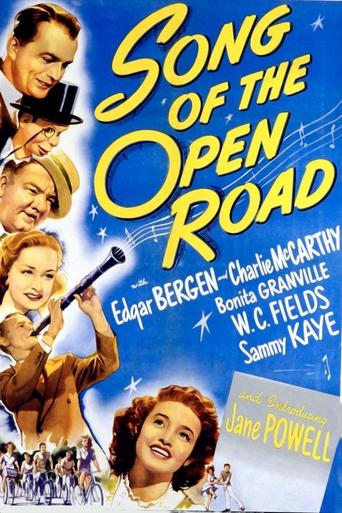
Song of the Open Road (1944)
A beautiful child star tires of life in the spotlight and so disguises herself and sneaks off to join a Civilian Conservation Corps camp to work with normal kids. It doesn't take her long to discover that being "normal" isn't easy as it looks. When a crop is in danger of being ruined because there are not enough people to harvest it, the girl employs some of her famous colleagues to lend a hand. Songs include: "Too Much in Love," "Here It Is Monday," "Delightfully Dangerous," "Hawaiian War Chant" and "Notre Dame."
- Fecha de estreno
- 1944-06-21
- TMDB
- 7.0 / 10 (2)
- Duración
- 1 h 33 min
- Géneros
- Comedia
- Director
- S. Sylvan Simon
Reparto
- Edgar Bergen — Edgar Bergen
- Bonita Granville — Bonnie
- W.C. Fields — W.C. Fields
- Jane Powell — Jane Powell
- Peggy O'Neill — Peggy
- Reginald Denny — Director Curtis
- Jackie Moran — Jack Moran
- Sammy Kaye — Orchestra Leader
- Bill Christy — Bill
- Regis Toomey — Connors
- Rose Hobart — Mrs. Powell
- Hugh Beaumont — John Moran (uncredited)
Curiosidades
- Rodada en: California
- Premios: 0 · Nominaciones: 1
Song of the Open Road is a 1944 musical comedy film directed by S. Sylvan Simon, from a screenplay by Irving Phillips and Edward Verdier. It was the debut film of teenage singer Jane Powell. Powell's real name was Suzanne Burce, but prior to the release of this film MGM assigned her the stage name "Jane Powell".
Production
Director S. Sylvan Simon had difficulty filming scenes with W. C. Fields because of Fields' alcoholism.
Although Fields often made fun of singers and singing in general, he had a fondness for the promising young singer Jane Powell and even referred to her (as "little Janie Powell") on one of his CBS radio broadcasts (preserved on transcription discs). Powell sang several songs in the film and made such an impression that MGM signed her to a contract to make a number of musical comedies for them, through the mid-1950s.
Location shooting was done in Palm Springs, California and at the Pan-Pacific Auditorium in Los Angeles.
This was W. C. Fields's next-to-last film; his last (Sensations of 1945) would be released only 9 days after this film was issued. In the film, Fields—who began his career as an accomplished juggler—plays himself and juggles some oranges for a few moments. He remarks "This used to be my racket". Then, missing a catch, he drops the oranges and walks away muttering "used to be my racket, but it isn't anymore!"
The film also has a brief continuation of the long-running feud between Fields and woodenhead dummy Charlie McCarthy with a new twist: "Charlie McCarthy Jr." is a miniature version of the dummy that sits on the larger dummy's knee with Charlie as his ventriloquist. The sight of this has Fields throwing away his bottle and vowing to give up drinking.
Leer en Wikipedia · Texto de Wikipedia, CC BY-SA 4.0. Datos de Wikidata.
Recomendadas
- Sneakerella: Cenicienta en zapatillas 2022 · ★ 5.9
- Curly Top 1935 · ★ 6.5
- Arlo, el chico caimán 2021 · ★ 6.8
- Jordan-manía! 2004 · ★ 6.1
- Tienda de locos 1941 · ★ 6.3
- John Mulaney & The Sack Lunch Bunch 2019 · ★ 7.0
- La Gran Aventura De Blue En La Ciudad 2022 · ★ 7.1
- Dolly Parton: Navidad en la plaza 2020 · ★ 5.9
- Los gatos no bailan 1997 · ★ 7.2
- Amor en conserva 1949 · ★ 5.8
- UglyDolls: Extraordinariamente feos 2019 · ★ 6.6
- El novato del año 1993 · ★ 6.2