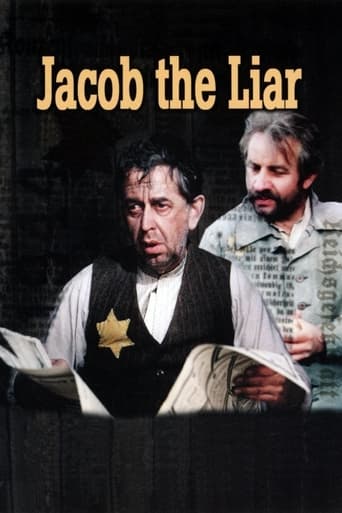
Jacob the Liar (1974)
Jakob der Lügner
A Jewish ghetto in the east of Europe, 1944. By coincidence, Jakob Heym eavesdrops on a German radio broadcast announcing the Soviet Army is making slow by steady progress towards central Europe. In order to keep his companion in misfortune, Mischa, from risking his life for a few potatoes, he tells him what he heard and announces that he is in possession of a radio - in the ghetto a crime punishable by death. It doesn't take long for word of Jakob's secret to spread - suddenly, there is new hope and something to live for - and so Jakob finds himself in the uncomforting position of having to come up with more and more stories.
- Date of release
- 1974-12-22
- TMDB
- 6.9 / 10 (29)
- Runtime
- 1h 40m
- Genres
- History, Drama, Comedy
- Director
- Frank Beyer
Casting
- Vlastimil Brodský — Jakob Heym
- Erwin Geschonneck — Kowalski
- Henry Hübchen — Mischa
- Blanche Kommerell — Rose Frankfurter
- Manuela Simon — Lina
- Zsuzsa Gordon — Mrs. Frankfurter
- Armin Mueller-Stahl — Roman Schlamm
- Friedrich Richter — Dr. Kirschbaum
- Margit Bara — Josefa
- Reimar Johannes Baur — Herschel Schlamm
- Dezső Garas — Frankfurter
- Hermann Beyer — Wachhabender
Interesting facts
- Awards: 0 · Nominations: 2
Jacob the Liar is a 1974 war drama film directed by Frank Beyer, adapted by Beyer and Jurek Becker from the latter's novel of the same title. Set in Nazi-occupied Poland during the Holocaust, the film centers on Jakob Heym, a Polish Jew who attempts to raise the morale inside the ghetto by sharing encouraging rumors that he claims he has heard on an (imaginary) radio. The film was a co-production between East Germany and Czechoslovakia. It premiered on East German television on 22 December 1974, and was released theatrically on 18 April 1975.
Production
While still attending university, Jurek Becker heard from his father a story about a man from the Łódź Ghetto who owned a radio and passed news from the outside world, risking execution by the Germans. As Becker became a screenwriter in the early 1960s, he decided to compose a film script based on the story.
During 1965, as work on the script progressed, Frank Beyer requested to direct the future film and received the role. On 9 February 1966, the director-general of DEFA, Franz Bruk, submitted the script to the chairman of the Ministry Of Culture's Film Department, Wilfried Maaß, and requested permission to commence production.
The producers soon encountered difficulties. At the end of 1965, from the 16th to the 18th of December, the Socialist Unity Party of Germany assembled for its XI Plenum. During the convention, the cinema industry was severely criticized and blamed for taking artistic liberties incongruous with Marxist ideology.
Becker's biographer Beate Müller wrote that while the implications of the Plenum played a part in this, "it would be misleading to lay all responsibility there": neither Becker nor the film were mentioned by the Party, and DEFA might have simply found another director. Beyer wrote the film was deemed sound on the political level, adding the censure never tried to interfere with Jacob the Liar.
The rejection of the film motivated Becker to turn his screenplay into a novel. Jacob the Liar was first published in 1969, and became both a commercial and a critical success, winning several literary prizes, also in West Germany and abroad. The acclaim it received motivated the West German ZDF television network to approach the author and request the rights to adapt it.
Read on Wikipedia · Text from Wikipedia, CC BY-SA 4.0. Data from Wikidata.
Recommended
- Jakob the Liar 1999 · ★ 6.7
- The Survivor 2022 · ★ 6.8
- Rhinegold 2022 · ★ 6.5
- The Eichmann Show 2015 · ★ 6.7
- Playing for Time 1980 · ★ 6.9
- A Call to Spy 2020 · ★ 6.8
- Resistance 2020 · ★ 7.0
- Notorious 2009 · ★ 7.0
- Naked Among Wolves 2015 · ★ 7.3
- The Way Back 2010 · ★ 7.0
- The Last Word 2017 · ★ 6.6
- 13 Minutes 2015 · ★ 6.8