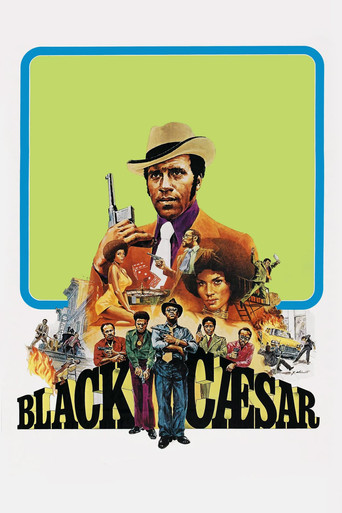
Black Caesar (1973)
Hail Caesar Godfather of Harlem!
Raised in Harlem, Tommy Gibbs becomes a successful mob boss but he clashes with the rival Mafia and his old enemy, dirty cop McKinney.
- Date of release
- 1973-02-07
- TMDB
- 5.9 / 10 (96)
- Runtime
- 1h 35m
- Genres
- Crime, Action
- Director
- Larry Cohen
- Collection
- Tommy Gibbs Collection
Casting
- Fred Williamson — Tommy Gibbs
- Gloria Hendry — Helen
- Art Lund — McKinney
- D'Urville Martin — Rev. Rufus
- Julius Harris — Mr. Gibbs
- Minnie Gentry — Mama Gibbs
- Philip Roye — Joe Washington
- William Wellman Jr. — Alfred Coleman
- James Dixon — "Irish" Bryant
- Val Avery — Cardoza
- Patrick McAllister — Grossfield
- Don Pedro Colley — "Craw"
Interesting facts
Black Caesar is a 1973 American blaxploitation crime drama film written and directed by Larry Cohen and starring Fred Williamson, Gloria Hendry and Julius Harris. It features a musical score, Black Caesar, by James Brown, with heavy input from his bandleader Fred Wesley, his first experience with writing music for film. A sequel titled Hell Up in Harlem was released in late 1973.
Production
The film script was originally commissioned by Sammy Davis Jr. According to Larry Cohen, Davis "wanted to do a picture in which he was the star, instead of being a flunky to Frank Sinatra and Dean Martin. So I suggested that they do a gangster movie like Little Caesar, since he was a little guy, and so was Jimmy Cagney, and so was Edward G. Robinson. And I thought he could play a little hoodlum working his way up in the Harlem underworld."
Cohen wrote a treatment for $10,000 but when he finished, Davis could not pay due to some trouble with the Internal Revenue Service. Cohen was approached by Samuel Z. Arkoff of American International Pictures, who were interested in doing an action film that could star a black actor. Cohen produced the treatment he had written for Davis and AIP agreed to finance.
Most of the film was shot in New York, although some interiors were filmed in Los Angeles. Fred Williamson was cast in the lead as Tommy Gibbs. Cohen says, "Fred was totally different than what Sammy would have played, because Fred was a handsome leading man. He looked great in the clothes, and he looked great in that hat that I put on him.
Cohen says when he filmed in Harlem the local gangsters threatened to disrupt the shoot unless they were paid off. He offered them small roles in the film instead. "These guys were great," he said. "Anything we wanted, anything we needed to get, they got for me. We kind of owned Harlem after that. And then when the picture finally opened, I put them in the poster too, so that the advertisements in the paper had these guys in it.
Stevie Wonder was originally asked to score the film, but after Cohen screened a rough cut for him, Wonder was worried about being associated with a film so violent, so he declined the job and was replaced by James Brown.
Read on Wikipedia · Text from Wikipedia, CC BY-SA 4.0. Data from Wikidata.
Recommended
- Across 110th Street 1972 · ★ 6.7
- Cotton Comes to Harlem 1970 · ★ 6.2
- Foxy Brown 1974 · ★ 6.3
- I'm Gonna Git You Sucka 1988 · ★ 6.4
- Fast Charlie 2023 · ★ 6.3
- The Mack 1973 · ★ 6.4
- The Human Tornado 1976 · ★ 6.1
- Shaft 1971 · ★ 6.4
- Black Belt Jones 1974 · ★ 6.0
- Coffy 1973 · ★ 6.6
- Al Capone 1959 · ★ 6.6
- State Property 2002 · ★ 6.4