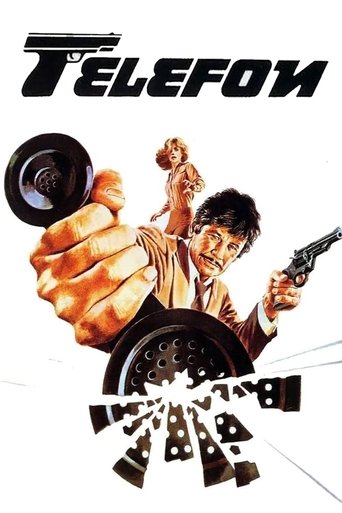
Telefon (1977)
They'll do anything to stop Telefon. The operation that can trigger 51 human time bombs.
Nicolai Dalchimski, a mad KGB agent steals a notebook full of names of "sleeping" undercover KGB agents sent to the U.S. in the 1950's. These agents got their assignments under hypnosis, so they can't remember their missions until they're told a line of a Robert Frost poem. Dalchimski flees to the U.S. and starts phoning these agents who perform sabotage acts against military targets.
- Date of release
- 1977-12-16
- TMDB
- 6.6 / 10 (143)
- Runtime
- 1h 42m
- Genres
- Thriller, Action
- Director
- Don Siegel
Casting
- Charles Bronson — Major Grigori Borzov
- Lee Remick — Barbara
- Donald Pleasence — Nicolai Dalchimsky
- Tyne Daly — Dorothy Putterman
- Alan Badel — Colonel Malchenko
- Patrick Magee — General Strelsky
- Sheree North — Marie Wills
- Roy Jenson — Doug Stark
- John Mitchum — Harry Bascom
- Jacqueline Scott — Mrs. Hassler
- Frank Marth — Harley Sandburg
- Helen Page Camp — Emma Stark
Interesting facts
- Based on: Telefon
- Filmed in: Finland
Telefon is a 1977 spy film directed by Don Siegel and starring Charles Bronson, Lee Remick and Donald Pleasence. The screenplay by Peter Hyams and Stirling Silliphant is based on the 1975 novel by Walter Wager.
Production
MGM bought the film rights to the novel in October 1974. The novel was published in April 1975. The New York Times called the novel "a doozie of a thriller".
Peter Bellwood was the first writer. Then Peter Hyams wrote a script. Hyams says Dan Melnick then head of MGM told him he wanted Hyams to write and direct, but his last film Peeper had flopped and Hyams said "he knew there was no way he was going to let me direct it." They did like the script but brought in Richard Lester to direct. Hyams rewrote the script for Lester, who then left the project and Don Siegel came on board.
In August 1976 it was announced Don Siegel would direct and Charles Bronson would star. Siegel had directed Bronson in TV in the late 50s and said "I wanted to do this one because of Bronson. I think we would make a natural team."
Bronson's wife Jill Ireland often worked with her husband and Bronson said the female lead was "perfect for her" but he did not insist and Lee Remick was cast instead.
Martin Elfand was originally producer of the film but in November 1976 was named executive vice president in charge of production at Warner Bros. and James B. Harris took over producing, with Elfand being credited as executive producer.
Read on Wikipedia · Text from Wikipedia, CC BY-SA 4.0. Data from Wikidata.
Recommended
- The Kremlin Letter 1970 · ★ 5.9
- Gorky Park 1983 · ★ 6.3
- The November Man 2014 · ★ 6.1
- The Gray Man 2022 · ★ 6.9
- Red Sparrow 2018 · ★ 6.5
- American Assassin 2017 · ★ 6.4
- Canary Black 2024 · ★ 6.2
- Salt 2010 · ★ 6.4
- Three Days of the Condor 1975 · ★ 7.3
- Child 44 2015 · ★ 6.3
- Shining Through 1992 · ★ 6.5
- All the Old Knives 2022 · ★ 6.0