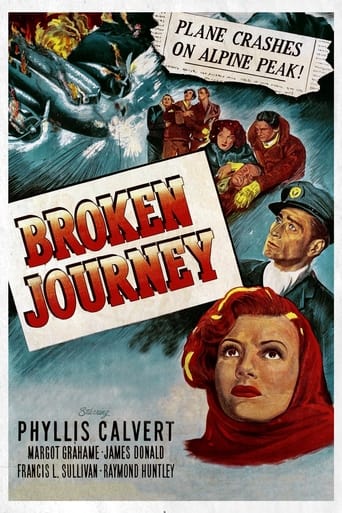
Broken Journey (1948)
A plane flying over the Swiss Alps develops engine trouble and is forced to crash-land on a glacier. Unable to radio for help because of damaged batteries and with limited food supplies, the survivors must come to a decision -- whether to stay and wait for help they believe is coming or to leave the shelter of the wrecked plane and set out in bad weather to try to reach civilization.
- Date of release
- 1948-04-14
- TMDB
- 6.1 / 10 (8)
- Runtime
- 1h 29m
- Genres
- Drama
- Director
- Ken Annakin, Michael C. Chorlton
Casting
- Phyllis Calvert — Mary Johnstone
- James Donald — Bill Haverton
- Margot Grahame — Joanna Dane
- Francis L. Sullivan — Anton Perami
- Guy Rolfe — Captain Fox
- David Tomlinson — Jimmy Marshall
- Raymond Huntley — Edward Marshall
- Derek Bond — Richard Faber
- Grey Blake — John Barber
- Sonia Holm — Anne Stephens
- Andrew Crawford — Kid Cormack
- Charles Victor — Harry Gunn
Interesting facts
Broken Journey is a 1948 British drama film directed by Ken Annakin and featuring Phyllis Calvert, James Donald, Margot Grahame, Raymond Huntley and Guy Rolfe. It was written by Robert Westerby. The film centers on passengers and crew who struggle to survive after their airliner crashes on top of a mountain; it is based on a true-life accident in the Swiss Alps.
Production
The plot of Broken Journey closely approximated the 1946 C-53 Skytrooper crash on the Gauli Glacier, Switzerland in November 1946. The improvised operation that eventually resulted in the successful rescue of eight passengers and four crew members, considered the "birth of air-rescue in Switzerland", garnered worldwide publicity and led to the fictionalised account of Broken Journey.
Sydney Box became head of production of Gainsborough Studios in 1946. He commissioned Robert Westerby, who had a reputation for writing contemporary thrillers, to do a script. Michael Balcon was also developing a film based on the same story, and registered an idea with the British Producers Association, but once he heard Box was doing a film as well he withdrew his project.
Westerby did a treatment in six days, then proceeded to a full draft. He wrote the role of Mary Johnstone specifically for Phyllis Calvert, then one of the studio's biggest stars. Calvert was reluctant to make the film but Box managed to persuade her. It would be the last film Calvert made under her contract with Gainsborough.
Ken Annakin had a background in documentary filmmaking and had just directed his first feature for Sydney Box, Holiday Camp (1947), so Box assigned the film to him. While Westerby wrote his script, Box sent Annakin out to Mont Blanc to look for possible locations and gave him funds to purchase an old Dakota airplane.
When Annakin returned to London, Westerby had written a first draft in two weeks. Annakin said the script "read beautifully" with "twelve picturesque characters" who "all had what seemed to be interesting gimmicks, but when I got down to filming them, I found they were cardboard characters. No matter how neatly they were dovetailed into the plot, one didn’t care for them.
Read on Wikipedia · Text from Wikipedia, CC BY-SA 4.0. Data from Wikidata.
Recommended
- Alive 1993 · ★ 6.9
- Island in the Sky 1953 · ★ 6.2
- Arctic 2018 · ★ 6.5
- Clouds of Sils Maria 2014 · ★ 6.6
- The Edge 1997 · ★ 6.9
- Downhill Racer 1969 · ★ 6.0
- The Mountain 1956 · ★ 6.9
- 1 2020 · ★ 6.7
- Road to Paloma 2014 · ★ 5.8
- Meltdown: Days of Destruction 2006 · ★ 6.0
- Edie 2018 · ★ 6.3
- Gigi & Nate 2022 · ★ 7.7