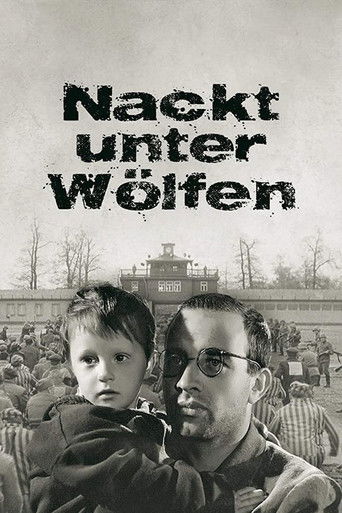
裸露在狼群 (1963)
Nackt unter Wölfen
1945年4月,德国法西斯崩溃前夕。布痕瓦尔德集中营来了一批从奥斯威辛集中营转来的“犯人”。队伍中,波兰犹太人扬科夫斯基的一只皮箱引起了在押“犯人”赫菲尔、皮匹希的注意。当党卫军把扬科夫斯基赶进营房时,赫菲尔和皮匹希把箱子带回自己的营房。打开箱盖,里面藏着一个四岁的男孩。怎么办?如果把孩子交出去,他肯定要被法西斯杀害。藏起来呢?万一被法西斯发现,大人也都将丧命。赫菲尔立即请示集中营的地下党领导人博霍夫。八年的集中营生活,使这位地下党领导人变得十分冷酷。他不愿为了这个孩子而牵连更多的人。他让赫菲尔把孩子交还给扬科夫斯基。赫菲尔知道,这等于亲手杀死这个可爱的孩子。
- 上映日期
- 1963-04-10
- TMDB
- 6.3 / 10 (25)
- 片长(分钟)
- 2小时4分钟
- 类型
- 剧情, 战争
- 导演
- Frank Beyer
演员阵容
- Erwin Geschonneck — Krämer
- 阿明·缪勒-斯塔尔 — Höfel
- Fred Delmare — Pippig
- Gerry Wolff — Bochow
- Виктор Авдюшко — Bogorski
- Zygmunt Malanowicz — Przybyła
- Erik S. Klein — Reineboth
- Herbert Köfer — Kluttig
- Wolfram Handel — Zweiling
- Bolesław Płotnicki — Kodiczek
- Heinz Scholz — Schwahl
- Peter Sturm — Rose
趣闻
- 改编自:裸露在狼群 (小说)
Naked Among Wolves is a 1963 East German film directed by Frank Beyer and starring Erwin Geschonneck and Armin Mueller-Stahl. The film is based on author Bruno Apitz's 1958 novel by the same name. The film was remade in 2015 under the direction of Philipp Kadelbach.
Production
Bruno Apitz, a member of the Communist Party of Germany, was incarcerated at Buchenwald concentration camp from 1937 to 1945. He later recalled that in the last months before liberation, he heard about a little Jewish child who had been harbored by the International Camp Committee and protected from the SS guards. In a 1974 interview, Apitz claimed he swore that "If I will survive, I will tell the story of this child."
After the war, Apitz resided in the German Democratic Republic, working as a journalist and as a dramatist in the state-owned DEFA Studio. On 27 November 1954, Apitz wrote to DEFA's director-general Hans Rodenberg and suggested producing a film about the child's story.
Apitz abandoned the idea to make a film and instead, turned his rudimentary screenplay into a novel. He wrote the book from 1955 to 1958. Historian Bill Niven commented that since April 1955, the 10th anniversary of the camp's liberation, "the collective memory of Buchenwald's communist prisoners was transformed into the official memory of the Socialist Unity Party of Germany", and incorporated into the country's "anti-Fascist legitimization myth…
Already in April 1959, DEFA chief dramatist Klaus Wischnewski contacted Apitz with a proposition to adapt his novel for the screen, but the author was unwilling and made demands which the studio was unable to accept. Representatives of the Deutscher Fernsehfunk station approached Apitz, and he agreed to produce a television film based on his novel, which was broadcast on 10 April 1960.
During 1960, after prolonged negotiations, Apitz and DEFA settled on an arrangement. Director Wolfgang Langhoff was chosen to direct the planned picture. Being engaged in his duties as manager of the Deutsches Theater, he eventually declined the role. It was then passed on to the young Frank Beyer, who had been working on Star-Crossed Lovers. In early 1962, he and Apitz began working on the planned film.
在维基百科阅读更多 · 文本来自维基百科,CC BY-SA 4.0。数据来自 Wikidata。