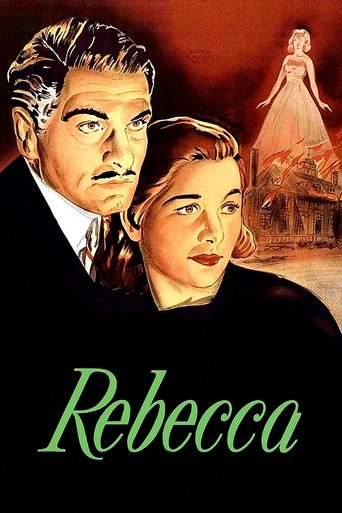
Rebecca (1940)
"Last night I dreamt I went to Manderley again..."
Story of a young woman who marries a fascinating widower only to find out that she must live in the shadow of his former wife, Rebecca, who died mysteriously several years earlier. The young wife must come to grips with the terrible secret of her handsome, cold husband, Max De Winter. She must also deal with the jealous, obsessed Mrs. Danvers, the housekeeper, who will not accept her as the mistress of the house.
- Date of release
- 1940-03-23
- TMDB
- 7.9 / 10 (2102)
- Runtime
- 2h 10m
- Genres
- Mystery, Romance, Thriller
- Director
- Alfred Hitchcock
Casting
- Laurence Olivier — Maxim de Winter
- Joan Fontaine — Mrs. de Winter
- George Sanders — Jack Favell
- Judith Anderson — Mrs. Danvers
- Gladys Cooper — Beatrice Lacy
- Nigel Bruce — Giles Lacy
- Reginald Denny — Frank Crawley
- C. Aubrey Smith — Colonel Julyan
- Melville Cooper — Coroner
- Florence Bates — Edythe Van Hopper
- Leonard Carey — Ben
- Leo G. Carroll — Dr. Baker
Interesting facts
- Based on: Rebecca
- Awards: 3 · Nominations: 11. Including: Academy Award for Best Picture; Academy Award for Best Cinematography, Black-and-White; National Board of Review: Top Ten Films
Rebecca is a 1940 American romantic psychological thriller film directed by Alfred Hitchcock. It was Hitchcock's first American project, and his first film under contract with producer David O. Selznick. The screenplay by Robert E. Sherwood and Joan Harrison, and adaptation by Philip MacDonald and Michael Hogan, were based on the 1938 novel of the same name by Daphne du Maurier.
Production
Principal photography on Rebecca began on 8 September 1939, having been postponed twice from 30 August and then 5 September. The film was budgeted at $800,000 and 36 days of shooting, but went significantly behind schedule, ultimately concluding after 63 days on 20 November 1939. The start of production coincided with the beginning of World War II, Britain having declared war on Germany on 3 September.
Selznick initially assigned Harry Stradling as cinematographer, but he withdrew from the project after the distressing experience of being fired from Intermezzo by Selznick. Selznick sought Gregg Toland as a replacement, but, finding him unavailable, instead hired Toland's mentor, George Barnes.
Art director Lyle Wheeler designed 40 sets for Rebecca, 25 of them interiors, mostly of Manderley. Matte painting was used to fill out shots of the sets with hand-painted details such as upper walls, ceilings and chandeliers.
Two miniatures of Manderley were created. The larger miniature occupied most of a large stage. It was used for relatively close shots, such as the views of flames through the windows during the burning of Manderley. The size of this miniature made it impossible to position a camera to encompass the full house and grounds, so a smaller version was constructed for long shots. This half-size miniature was used for the opening of the film.
Hitchcock later said that Selznick wanted the smoke from the burning Manderley to spell out a huge "R", which Hitchcock thought lacked subtlety. While Selznick was preoccupied by Gone with the Wind (1939), Hitchcock was able to replace the smoky "R" with the burning of a monogrammed négligée case lying atop a bed pillow.
Read on Wikipedia · Text from Wikipedia, CC BY-SA 4.0. Data from Wikidata.
Recommended
- Safe Haven 2013 · ★ 7.2
- The House of Fear 1945 · ★ 6.9
- Sherlock Holmes Faces Death 1943 · ★ 6.9
- Night Train to Lisbon 2013 · ★ 6.5
- Vertigo 1958 · ★ 8.1
- Overdrive 2017 · ★ 6.1
- Bunny Lake Is Missing 1965 · ★ 7.2
- The Seven-Ups 1973 · ★ 6.3
- Sherlock Holmes in Washington 1943 · ★ 6.7
- Woman on the Run 1950 · ★ 6.8
- The Lodger: A Story of the London Fog 1927 · ★ 7.2
- 23 Paces to Baker Street 1956 · ★ 6.7