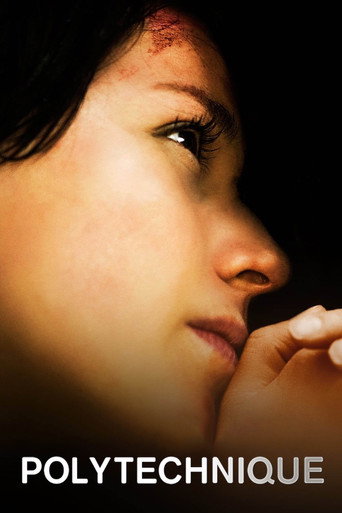
Polytechnique (2009)
A dramatization of the École Polytechnique massacre in Montreal, on December 9, 1989, where 14 female engineering students were murdered (and 13 were wounded) by a 25 year old psychotic misogynist armed with a semi-automatic weapon.
- Date of release
- 2009-02-06
- TMDB
- 7.1 / 10 (725)
- Runtime
- 1h 17m
- Genres
- Crime, Drama, Thriller
- Director
- Denis Villeneuve
Casting
- Maxim Gaudette — The Assassin
- Sébastien Huberdeau — Jean-François
- Karine Vanasse — Valérie
- Evelyne Brochu — Stéphanie
- Martin Watier — Jean-François (voice)
- Johanne-Marie Tremblay — Jean-François' Mother
- Natalie Hamel-Roy — Jean-François' Mother (voice)
- Pierre-Yves Cardinal — Éric
- Pierre Leblanc — Mr. Martineau
- Francesca Barcenas — Injured Student at Copier
- Ève Duranceau — Student with the Ear Injury
- Mathieu Ledoux — Injured Student
Interesting facts
- Budget: $6M
- Based on: École Polytechnique massacre
- Filmed in: Montreal
- Awards: 1 · Nominations: 0. Including: Academy of Canadian Cinema and Television Award for Best Motion Picture
Polytechnique is a 2009 Canadian tragedy film directed by Denis Villeneuve and written by Villeneuve and Jacques Davidts. Starring Maxim Gaudette, Sebastien Huberdeau, and Karine Vanasse, the film is based on the 1989 École Polytechnique massacre and re-enacts the events of the incident through the eyes of two students who witness a gunman (Gaudette) murder fourteen young women.
Production
Karine Vanasse, who played Valérie, helped produce Polytechnique, and wanted to make a film about the massacre for years. She helped secure director Denis Villeneuve for the film, who at the time was respected for making the 2000 film Maelström. Despite the sensitivity to the incident in Quebec, Villeneuve asserted it was not too soon for a film, and that there was an important conversation to be had.
Vanasse researched by speaking to the families of women killed in École Polytechnique de Montréal. In the film, one of the women tells The Killer that the students are not feminists, with Vanasse explaining, "One of the women who was there told me that it was the first time in her life that she had to confront her femininity head on".
École Polytechnique de Montréal gave the filmmakers the right to use the campus as a location, but Villeneuve opted against filming there to be respectful. The film was shot at Cégep de Maisonneuve and Collège Ahuntsic as well as Griffintown and Westmount. Villeneuve shot the film in black and white, so as to avoid the presence of blood on screen.
There were two versions of the film produced, one in English and one in French. The director Denis Villeneuve hoped the film would enter into the English-Canadian market, as well as the U.S. one. Villeneuve said the subject matter was challenging for the cast and crew to work with.
Read on Wikipedia · Text from Wikipedia, CC BY-SA 4.0. Data from Wikidata.
Recommended
- Elephant 2003 · ★ 7.0
- Nitram 2021 · ★ 6.9
- Red Rooms 2023 · ★ 7.1
- Barron's Cove 2025 · ★ 7.1
- M 1951 · ★ 6.5
- Cape Fear 1962 · ★ 7.4
- The Life of David Gale 2003 · ★ 7.4
- Light It Up 1999 · ★ 6.6
- Perfect Nanny 2019 · ★ 6.0
- The Life Before Her Eyes 2008 · ★ 6.0
- Mesrine: Killer Instinct 2008 · ★ 7.3
- The Adversary 2002 · ★ 6.6