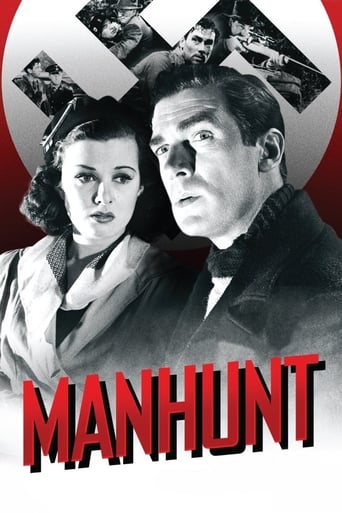
Man Hunt (1941)
One of the Most Gripping Scenes Ever Filmed...as two world-famous hunters stalk each Other!
Shortly before the start of WW2, renowned British big-game hunter Alan Thorndike, vacationing in Bavaria, has Hitler in his gun sight. He is captured, beaten, left for dead, and escapes back to London where he is hounded by Nazi agents and aided by a young woman.
- Date of release
- 1941-06-13
- TMDB
- 6.9 / 10 (134)
- Runtime
- 1h 45m
- Genres
- Thriller, War
- Director
- Fritz Lang
Casting
- Walter Pidgeon — Captain Alan Thorndike
- Joan Bennett — Jerry Stokes
- George Sanders — Major Quive-Smith
- John Carradine — Mr. Jones
- Roddy McDowall — Vaner
- Ludwig Stössel — Doctor
- Heather Thatcher — Lady Alice Risborough
- Frederick Worlock — Lord Gerald Risborough
- Roger Imhof — Captain Jensen
- Holmes Herbert — Saul Farnsworthy
- Egon Brecher — Jeweler
- Eily Malyon — Postmistress
Interesting facts
Man Hunt is a 1941 American political thriller film, directed by Fritz Lang and starring Walter Pidgeon and Joan Bennett. It is based on the 1939 novel Rogue Male by Geoffrey Household and is set in Europe just prior to the Second World War. Lang had fled Germany into exile in 1933 and this was the first of his four anti-Nazi films, which include Ministry of Fear, Hangmen Also Die!, and Cloak and Dagger. It was Roddy McDowall's first Hollywood film after escaping London following the Blitz. Man Hunt was one of many films released in 1941 that were considered so pro-British that they influenced neutral members of the U.S. public to sympathize with the British side in World War II.
Production
Man Hunt became the first war film to attract the attention of the Hays Office in the neutral United States. Joseph Breen was alarmed by the script, calling it a "hate film". Breen felt that in the isolationist atmosphere of the 1941 U.S., the film showed all Germans as evil, unlike other films that depicted both good non-Nazi Germans, as well as evil Nazis.
Darryl F. Zanuck was also worried about Lang's anti-Nazi enthusiasm and banned him from the editing room. However, Lang and his associate Gene Fowler, Jr. secretly edited the film without Zanuck's approval.
Isolationists and Nazi sympathizers took issue with the film, along with That Hamilton Woman (1941) and others, describing such films as pro-British propaganda to change American public opinion about going to war.
The film features an instrumental version of "A Nightingale Sang in Berkeley Square" by Eric Maschwitz, Manning Sherwin, and Jack Strachey as a recurring romantic theme. The score's recurring theme for the Nazis was composed by the film's musical director Alfred Newman.
Read on Wikipedia · Text from Wikipedia, CC BY-SA 4.0. Data from Wikidata.
Recommended
- The Ministry of Ungentlemanly Warfare 2024 · ★ 7.0
- The Eagle Has Landed 1976 · ★ 6.7
- North by Northwest 1959 · ★ 8.0
- The Sea Wolves 1980 · ★ 5.9
- Night Train to Munich 1940 · ★ 7.2
- Decision Before Dawn 1951 · ★ 6.8
- Five Graves to Cairo 1943 · ★ 7.0
- The Sea Chase 1955 · ★ 6.3
- The Man Who Never Was 1956 · ★ 7.0
- Shooter 2007 · ★ 7.1
- Valkyrie 2008 · ★ 7.0
- The Living Daylights 1987 · ★ 6.6